Tumor hypoxia: Difference between revisions
CSV import |
CSV import |
||
| Line 42: | Line 42: | ||
[[Category:Oncology]] | [[Category:Oncology]] | ||
[[Category:Cell biology]] | [[Category:Cell biology]] | ||
<gallery> | |||
File:Tumour_stroma_and_extracellular_matrix_in_hypoxia.svg|Tumor hypoxia | |||
File:HIF_regulates_interactions_of_cancer_cells_with_ECM_and_ECM_biosynthesis.svg|Tumor hypoxia | |||
File:GLUT1_Tranporter.png|Tumor hypoxia | |||
File:6-Phosphofructo-2-kinase.png|Tumor hypoxia | |||
File:Pyruvate_dehydrogenase_phosphorylation_sites.png|Tumor hypoxia | |||
File:HIF-1_Glycolytic_Pathway.png|Tumor hypoxia | |||
File:Lactic-acid-3D-balls.png|Tumor hypoxia | |||
File:Metabolism_symbiosis.png|Tumor hypoxia | |||
</gallery> | |||
Latest revision as of 11:52, 18 February 2025
Condition of low oxygen in tumor tissues
Tumor hypoxia refers to a condition in which there is a deficiency of oxygen in the tumor microenvironment. This phenomenon is a common characteristic of solid tumors and has significant implications for cancer progression and treatment.
Pathophysiology[edit]
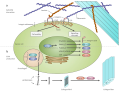
Tumor hypoxia occurs when the rapid growth of cancer cells outpaces the development of new blood vessels, leading to areas within the tumor that are poorly oxygenated. This hypoxic environment can influence tumor biology in several ways, including promoting angiogenesis, altering metabolism, and affecting cell signaling pathways.
Hypoxia-Inducible Factors[edit]
The primary cellular response to hypoxia is mediated by hypoxia-inducible factors (HIFs), which are transcription factors that regulate the expression of genes involved in adaptation to low oxygen conditions. HIF-1, in particular, plays a crucial role in the regulation of genes that control glycolysis, angiogenesis, and cell survival.

Metabolic Adaptations[edit]
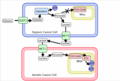
Under hypoxic conditions, cancer cells often switch from oxidative phosphorylation to anaerobic glycolysis to meet their energy demands. This metabolic shift is known as the Warburg effect.
Glycolytic Pathway[edit]
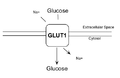
HIF-1 upregulates the expression of several glycolytic enzymes, including GLUT1 (glucose transporter 1), which facilitates increased glucose uptake, and 6-phosphofructo-2-kinase, which enhances glycolytic flux.

Lactate Production[edit]
The end product of anaerobic glycolysis is lactic acid, which accumulates in the tumor microenvironment, contributing to acidosis and further promoting tumor progression.

Impact on Treatment[edit]
Tumor hypoxia is associated with resistance to radiotherapy and certain chemotherapy agents. This resistance arises because oxygen is a potent radiosensitizer, and its absence reduces the effectiveness of radiation-induced DNA damage.
Research and Therapeutic Strategies[edit]
Efforts to overcome hypoxia-induced treatment resistance include the development of hypoxia-activated prodrugs and the use of agents that can modify the tumor microenvironment to improve oxygenation.
Related pages[edit]
References[edit]
-
 Tumor hypoxia
 -
 Tumor hypoxia
 -
 Tumor hypoxia
 -
 Tumor hypoxia
 -
 Tumor hypoxia
 -
 Tumor hypoxia
 -
 Tumor hypoxia
 -
 Tumor hypoxia


