Syn and anti addition: Difference between revisions
CSV import |
CSV import |
||
| Line 30: | Line 30: | ||
{{Chemistry-stub}} | {{Chemistry-stub}} | ||
<gallery> | |||
File:Markovnikov_and_Anti-Mark_Addition.svg|Syn_and_anti_addition | |||
File:Syn_&_anti_Addition_V.1.png|Syn_and_anti_addition | |||
File:Adice_halogenovodíku.PNG|Syn_and_anti_addition | |||
File:But-2-ene-hydration-2D-skeletal.svg|Syn_and_anti_addition | |||
File:Oxymercuration.svg|Syn_and_anti_addition | |||
File:Hydroboration_oxdation_of_alkene.png|Syn_and_anti_addition | |||
File:Alkeenide_antiasendatud_halogeenimine.png|Syn_and_anti_addition | |||
File:Dihydroxylation_(schematic)_Example_V.1.svg|Syn_and_anti_addition | |||
File:Hydrobromination_Crotonic_acid.svg|Syn_and_anti_addition | |||
File:Butanone_synthesis_from_2-butyne.svg|Syn_and_anti_addition | |||
File:Hydroboration-alkyne.svg|Syn_and_anti_addition | |||
</gallery> | |||
Latest revision as of 11:49, 18 February 2025
Syn and anti addition are fundamental concepts in organic chemistry, particularly in the context of addition reactions. These terms describe the stereochemical outcome of reactions where two substituents are added across a double or triple bond. Understanding the distinction between syn and anti addition is crucial for predicting the structure of reaction products and for synthesizing specific molecules with desired stereochemistry.
Overview[edit]
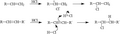
In a chemical reaction, when two substituents are added to adjacent carbon atoms in a double or triple bond, the spatial orientation of the incoming groups can be either on the same side (syn addition) or on opposite sides (anti addition) of the molecule. This orientation significantly affects the physical and chemical properties of the resulting compounds.
Syn Addition[edit]
Syn addition occurs when both substituents are added to the same side of the double or triple bond. This process leads to the formation of cis- or Z-stereoisomers, where the substituents are positioned on the same side of the molecule, creating a more crowded, but often more energetically favorable, configuration. Syn addition is characteristic of certain reactions such as hydrogenation using specific catalysts, and hydroboration-oxidation.
Anti Addition[edit]
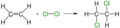
In contrast, anti addition involves the addition of substituents across a double or triple bond from opposite sides. This results in the formation of trans- or E-stereoisomers, where the substituents are positioned on opposite sides of the molecule, leading to a less crowded and more linear structure. Anti addition is typical of reactions like bromination and epoxidation followed by ring opening under certain conditions.
Mechanisms[edit]
The mechanisms underlying syn and anti additions involve various steps and intermediates, depending on the specific reaction and conditions.
Syn Addition Mechanism[edit]
Syn addition often proceeds through a concerted mechanism, where the bond formation to both substituents occurs simultaneously, without the formation of a discrete intermediate. An example is the syn addition of hydrogen in the presence of a suitable catalyst, where the hydrogen molecule is adsorbed onto the catalyst surface, facilitating its addition across the double bond from the same side.
Anti Addition Mechanism[edit]
Anti addition typically involves a stepwise mechanism, with the formation of a cyclic intermediate, such as a halonium ion in the case of halogen addition, or an epoxide in the case of oxygen addition. The intermediate then reacts with a nucleophile, leading to the addition of the second substituent from the opposite side of the initial bond.
Applications[edit]
Syn and anti addition reactions are widely used in organic synthesis to control the stereochemistry of the resulting molecules. These reactions are crucial for the synthesis of a wide range of compounds, including pharmaceuticals, agrochemicals, and materials with specific optical properties.
Conclusion[edit]
Understanding the concepts of syn and anti addition is essential for predicting the outcomes of addition reactions and for designing synthetic routes to obtain compounds with desired stereochemical configurations. These concepts underscore the importance of stereochemistry in organic chemistry and its implications for the physical, chemical, and biological properties of molecules.

-
 Syn_and_anti_addition
 -
 Syn_and_anti_addition
 -
 Syn_and_anti_addition
 -
 Syn_and_anti_addition
 -
 Syn_and_anti_addition
 -
 Syn_and_anti_addition
 -
 Syn_and_anti_addition
 -
 Syn_and_anti_addition
 -
 Syn_and_anti_addition
 -
 Syn_and_anti_addition
 -
 Syn_and_anti_addition


_Example_V.1.svg)


