Breton language: Difference between revisions
No edit summary |
CSV import |
||
| Line 34: | Line 34: | ||
{{Languages of France}} | {{Languages of France}} | ||
{{Endangered languages}} | {{Endangered languages}} | ||
<gallery> | |||
File:Huelgoat_Chaos_mill.jpg|Huelgoat Chaos mill | |||
File:Affiche_Charrue_Huard.jpg|Affiche Charrue Huard | |||
File:Breton_dialectes-en.svg|Breton dialects map | |||
File:Municipal_electronic_information_sign_in_Breton_in_Carhaix.jpg|Municipal electronic information sign in Breton in Carhaix | |||
File:Ofis_ar_Brezhoneg_vehicle.jpg|Ofis ar Brezhoneg vehicle | |||
File:Bilingual_sin_in_Gwened.jpg|Bilingual sign in Gwened | |||
File:Breton_school_sign_in_Rennes.jpg|Breton school sign in Rennes | |||
File:Road_signs_bilingual_Breton_in_Quimper.jpg|Road signs bilingual Breton in Quimper | |||
File:Flag_of_Brittany_(Gwenn_ha_du).svg|Flag of Brittany (Gwenn ha du) | |||
</gallery> | |||
Latest revision as of 11:49, 18 February 2025
Breton language is a Celtic language predominantly spoken in Brittany, a region in the northwest of France. It is one of the six extant Celtic languages and is most closely related to Cornish and more distantly to Welsh.
History[edit]
The Breton language, known as Brezhoneg in Breton, originated from the migration of Britons from the British Isles to the Armorican Peninsula, now known as Brittany, during the 5th to 7th centuries AD. This migration led to the establishment of a new Brittonic-speaking territory, separate from those that would eventually develop into Welsh, Cornish, and Cumbric.
[edit]
Breton is a member of the Brittonic branch of the Celtic languages, which also includes Welsh and Cornish. It is further classified within the Insular Celtic group, which also includes the Goidelic languages such as Irish, Scottish Gaelic, and Manx.
Geographic distribution[edit]
Breton is primarily spoken in Brittany, specifically in the western part of the region. There are also Breton-speaking communities in the Paris metropolitan area, known as the "Breton diaspora".
Status[edit]
Despite efforts to promote the Breton language, it is currently classified as "severely endangered" by UNESCO. However, there has been a revival movement in recent years, with an increase in the number of children attending bilingual or Breton-medium schools.
Phonology[edit]
Breton has a complex phonological system, with a distinction between voiceless and voiced consonants, and between oral vowels and nasal vowels. It also has a characteristic pitch accent.
Grammar[edit]
Breton grammar is characterized by VSO word order, the use of inflected prepositions, and a complex system of conjugation.
Writing system[edit]
The Breton language is written using the Latin script, with some additional diacritics. There are two main orthographic systems: the KLT (Kerne-Leon-Tregor) and the Peurunvan (or "Unified Breton").
See also[edit]
| Celtic languages | ||||||||||||||||||||||||||
|---|---|---|---|---|---|---|---|---|---|---|---|---|---|---|---|---|---|---|---|---|---|---|---|---|---|---|
Italics indicate extinct or ancestor languages
|
 Languages of France
 |
||||||||
|---|---|---|---|---|---|---|---|---|
See also: Language policy in France
|
| Endangered languages | ||||||||||
|---|---|---|---|---|---|---|---|---|---|---|
This endangered languages related article is a stub.
|
-
 Huelgoat Chaos mill
 -
 Affiche Charrue Huard
 -
 Breton dialects map
 -
 Municipal electronic information sign in Breton in Carhaix
 -
 Ofis ar Brezhoneg vehicle
 -
 Bilingual sign in Gwened
 -
 Breton school sign in Rennes
 -
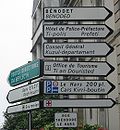 Road signs bilingual Breton in Quimper
 -
 Flag of Brittany (Gwenn ha du)


.svg)
