Utah: Difference between revisions
CSV import |
CSV import |
||
| Line 95: | Line 95: | ||
[[Category:States of the United States]] | [[Category:States of the United States]] | ||
[[Category:Utah]] | [[Category:Utah]] | ||
<gallery> | |||
File:California1838.jpg|Utah | |||
File:BrighamYoung1.jpg|Utah | |||
File:Sketch_of_Salt_Lake_1860.jpg|Utah | |||
File:Deseret_Village.jpg|Utah | |||
File:East_and_West_Shaking_hands_at_the_laying_of_last_rail_Union_Pacific_Railroad_-_Restoration.jpg|Utah | |||
File:Children_reading_1940.jpg|Utah | |||
File:Utah_Counties.png|Utah | |||
File:Arches_1_-_panoramio.jpg|Utah | |||
File:My_Public_Lands_Roadtrip-_Pariette_Wetlands_in_Utah_(20220345702).jpg|Utah | |||
File:LCLfallfoliage2005.JPG|Utah | |||
File:Deer_Creek_Reservoir.jpg|Utah | |||
File:American_Fork_Canyon_from_Timpanogos_Cave_entrance.jpg|Utah | |||
</gallery> | |||
Revision as of 11:47, 18 February 2025
State in the United States of America
Utah is a state in the Western United States. It became the 45th state admitted to the United States on January 4, 1896. Utah is bordered by Colorado to the east, Wyoming to the northeast, Idaho to the north, Arizona to the south, and Nevada to the west. It also touches a corner of New Mexico in the southeast. The state capital and largest city is Salt Lake City.
History
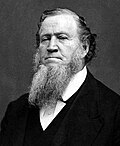
The area now known as Utah was inhabited by various indigenous groups, including the Ancestral Puebloans and the Fremont culture. The first European explorers to visit the region were the Spanish in the 18th century. In 1847, members of the Church of Jesus Christ of Latter-day Saints, led by Brigham Young, settled in the Salt Lake Valley, seeking a place to practice their religion free from persecution.


In 1850, the Utah Territory was established, and it included parts of present-day Colorado, Wyoming, and Nevada. The territory was a theocratic state led by the LDS Church until the Utah War in 1857-1858, when federal troops were sent to assert U.S. authority.
Geography
Utah is known for its diverse landscapes, ranging from arid deserts with sand dunes to thriving pine forests in mountain valleys. The state is home to five national parks: Zion National Park, Bryce Canyon National Park, Capitol Reef National Park, Arches National Park, and Canyonlands National Park.


Economy
Utah's economy is diverse, with major sectors including mining, agriculture, manufacturing, information technology, and tourism. The state is a major producer of copper, gold, silver, and other minerals. The Great Salt Lake is a significant source of salt and magnesium.
Demographics
As of the 2020 census, Utah had a population of approximately 3.2 million people. The state has a high birth rate and a young population, with a median age of 31. Utah is known for its large Latter-day Saint population, which influences the state's culture and politics.
Culture
Utah has a rich cultural heritage, with influences from Native American, Mormon, and immigrant communities. The state hosts numerous cultural events, including the Sundance Film Festival and the Utah Shakespeare Festival.
Education
Utah is home to several major universities, including the University of Utah, Brigham Young University, and Utah State University. The state has a strong emphasis on education, with a high literacy rate and a focus on STEM fields.
Transportation
Utah has a well-developed transportation network, including major highways such as Interstate 15 and Interstate 80. The state is served by the Salt Lake City International Airport, which is a hub for Delta Air Lines.
Gallery
-
 Completion of the First Transcontinental Railroad
 -
 Children reading in Utah, 1940
 -
 Map of Utah counties
 -
 Arches National Park
 -
 Pariette Wetlands
 -
 Fall foliage in Utah
 -
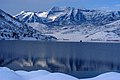 Deer Creek Reservoir
 -
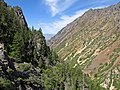 American Fork Canyon
 -
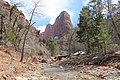 Kolob Canyon at Zion National Park
 -
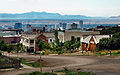
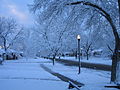 Streets of Rose Park, Salt Lake City
 -
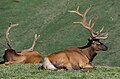 Rocky Mountain elk
 -
 California gull
 -
 Western black widow spider
 -
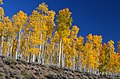 Pando, the world's largest organism
 -
 Mojave Desert
 -
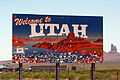 Welcome sign in Utah
 -
 Demographic map of Utah
 -
 Salt Lake Temple
 -
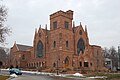 First Presbyterian Church, Salt Lake City
 -
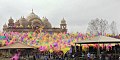 Festival of Colors at the Krishna Temple
 -
 City Creek Center
 -
 IM Flash Technologies
 -
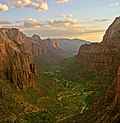 View from Angel's Landing, Zion National Park
 -
 Horses in Utah
 -
 Bryce Canyon National Park
 -
 Bingham Canyon Mine
 -
 Utah State Route 12
 -
 FrontRunner train at North Temple station
 -
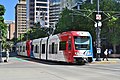 TRAX light rail at Gallivan Plaza
 -
 Salt Lake City International Airport
 -
 STS-51-D Space Shuttle crew
 -
 Utah State Capitol
 -
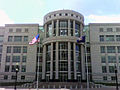 Matheson Courthouse
 -
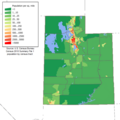 Population density map of Utah
 -
 Salt Lake City skyline
 -
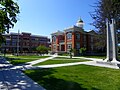 Logan Courthouse
 -
 Downtown Ogden
 -
 Park City
 -
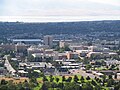 Provo, Utah
 -
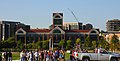 Sandy City Hall
 -
 Downtown St. George
 -
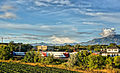 Kays Crossing with train
 -
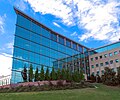 Huntsman Cancer Institute
 -
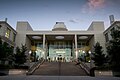 Eyring Science Center
 -
 2002 Winter Olympics flame
 -
 Utah Jazz basketball game
 -
 Real Salt Lake soccer match
 -
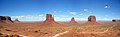 Monument Valley
 -
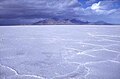 Salt flats in Utah


.jpg)


.jpg)


.jpg)


Related pages
-
 Utah
Utah -
 Utah
Utah -
 Utah
Utah -
 Utah
Utah -
Utah
-
Utah
-
Utah
-
Utah
-
Utah
-
Utah
-
Utah
-
Utah
