Chả lụa: Difference between revisions
CSV import Tags: mobile edit mobile web edit |
CSV import |
||
| Line 24: | Line 24: | ||
{{Vietnamese-cuisine-stub}} | {{Vietnamese-cuisine-stub}} | ||
{{food-stub}} | {{food-stub}} | ||
<gallery> | |||
File:Giò_lụa_2.jpg|Chả lụa | |||
File:Giò_lụa_3.jpg|Chả lụa | |||
File:Chalua.jpg|Chả lụa | |||
File:Giò_sống_nhà_làm,_tháng_6_năm_2020_(4).jpg|Chả lụa | |||
File:Chả_đặc_sản_chợ_Đông_Hà_(chả_được_gói_trong_lá_chuối)_năm_2017.jpg|Chả lụa | |||
File:Bún_bò_chả_và_mực_luộc_cho_bé_Na_(Cropped).jpg|Chả lụa | |||
File:Nhà_mình_dịp_Lễ_2th9n2023_(món_chả_chiên)_(2).jpg|Chả lụa | |||
File:Bữa_cơm_nhà_Mheo_ng19th2n2021_(dĩa_chả_quế)_(1).jpg|Chả lụa | |||
File:Tam_mu_yo.jpg|Chả lụa | |||
File:Yam_mu_yo_thot_khai_dao.jpg|Chả lụa | |||
</gallery> | |||
Latest revision as of 11:47, 18 February 2025
Chả lụa is a traditional Vietnamese dish, often considered the most popular and widely recognized sausage in Vietnamese culture. It is also known as Vietnamese ham or Vietnamese pork roll in English-speaking regions.
History[edit]
The origins of Chả lụa can be traced back to the Nguyễn Dynasty, where it was a staple food in the royal court. The dish has since become a common part of everyday meals in Vietnam, and is often served during special occasions and traditional festivals.
Preparation[edit]
Chả lụa is made from pork, which is pounded into a paste and mixed with fish sauce, salt, and black pepper. The mixture is then wrapped tightly in banana leaves and boiled until it solidifies into a firm, smooth texture. The banana leaves not only provide a natural casing for the sausage, but also impart a subtle, unique flavor to the dish.
Consumption[edit]
Chả lụa is typically sliced and eaten as is, or used as an ingredient in various Vietnamese dishes. It is a common filling in Bánh mì, a type of Vietnamese sandwich, and is also used in Bún chả, a noodle dish with grilled pork. In addition, it can be fried or steamed and served with nước chấm, a Vietnamese dipping sauce.
Cultural Significance[edit]
Chả lụa holds a significant place in Vietnamese culture. It is often prepared for Tết, the Vietnamese New Year, as a symbol of prosperity and good luck for the coming year. The dish is also a common offering in ancestor worship rituals, reflecting its deep roots in Vietnamese tradition.
See Also[edit]


-
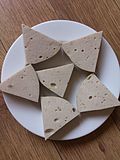 Chả lụa
 -
 Chả lụa
 -
 Chả lụa
 -
 Chả lụa
 -
 Chả lụa
 -
 Chả lụa
 -
 Chả lụa
 -
 Chả lụa
 -
 Chả lụa
 -
 Chả lụa


.jpg)
_n%C4%83m_2017.jpg)
.jpg)
_(2).jpg)
_(1).jpg)


