Countercurrent exchange: Difference between revisions
CSV import |
CSV import |
||
| Line 28: | Line 28: | ||
[[Category:Mechanical engineering]] | [[Category:Mechanical engineering]] | ||
{{stub}} | {{stub}} | ||
<gallery> | |||
File:Échange_de_chaleur_contre-courant.svg|Countercurrent exchange | |||
File:Heat_exchanger.svg|Countercurrent exchange | |||
File:Comparison_of_con-_and_counter-current_flow_exchange.jpg|Countercurrent exchange | |||
File:Delta_T_1.svg|Countercurrent exchange | |||
File:Spiral-heat-exchanger-schematic-workaround.svg|Countercurrent exchange | |||
File:Circulus_arteriosus_schaf.jpg|Countercurrent exchange | |||
File:Countercurrentmultiplier.jpg|Countercurrent exchange | |||
File:Kidney_nephron_molar_transport_diagram.svg|Countercurrent exchange | |||
File:Gray1128.png|Countercurrent exchange | |||
File:Arm_counter-current_flow.jpg|Countercurrent exchange | |||
File:Hardendale_Lime_Works_-_geograph.org.uk_-_73044.jpg|Countercurrent exchange | |||
File:Coflore_ACX.png|Countercurrent exchange | |||
</gallery> | |||
Latest revision as of 11:44, 18 February 2025
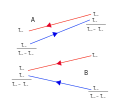
Countercurrent exchange is a mechanism occurring in nature and mimicked in industry and engineering, involving a crossover of some property, usually heat or some component, between two flowing bodies flowing in opposite directions to each other. The flowing bodies can be liquids, gases, or even solid powders, or any combination of those. For example, in a distillation column, it is the vapor and liquid phases that undergo a countercurrent exchange of heat and mass transfer.
Mechanism[edit]
The countercurrent exchange mechanism is very efficient in retaining high concentration gradients. Because the two flows are moving in opposite directions, the differential driving force or concentration gradient is maintained across the entire length of the exchange system.
Applications[edit]
Countercurrent exchange systems can be found in a multitude of processes. In biology, countercurrent exchange is used extensively in respiration, in the gills of fish, and in the villi of the human small intestine. In industry, it is used in processes such as distillation columns, gas scrubbers, and water treatment processes.
In Biology[edit]
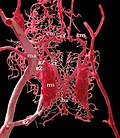
In biology, countercurrent exchange systems are used to enable high efficiency diffusion processes. This can be seen in the gills of fish, and in the villi of the human small intestine. In both cases, the countercurrent exchange system allows for the maintenance of a high concentration gradient, and therefore, high efficiency diffusion.
In Industry[edit]
In industry, countercurrent exchange systems are used in a variety of processes. In a distillation column, the vapor and liquid phases undergo a countercurrent exchange of heat and mass transfer. This allows for the separation of different components in a mixture. Similarly, in a gas scrubber, the gas and liquid phases undergo a countercurrent exchange, allowing for the removal of certain components from the gas phase.
See Also[edit]
References[edit]
<references />
 | |
|---|---|
 |
 |
-
 Countercurrent exchange
 -
 Countercurrent exchange
 -
 Countercurrent exchange
 -
 Countercurrent exchange
 -
 Countercurrent exchange
 -
 Countercurrent exchange
 -
Countercurrent exchange
-
Countercurrent exchange
-
Countercurrent exchange
-
Countercurrent exchange
-
Countercurrent exchange
-
Countercurrent exchange


