Fufu: Difference between revisions
No edit summary |
CSV import |
||
| Line 44: | Line 44: | ||
[[Category:Nigerian cuisine]] | [[Category:Nigerian cuisine]] | ||
{{stb}} | {{stb}} | ||
<gallery> | |||
File:Wrapped_fufu.jpg|Fufu | |||
File:Pounding_of_fufu.jpg|Pounding of fufu | |||
File:Eating_together_as_a_family.jpg|Eating together as a family | |||
File:Fufu.jpg|Fufu | |||
File:Fufu-palmnutsoup.jpg|Fufu with palm nut soup | |||
File:Foufou.jpg|Fufu | |||
File:Nigerian_Food_Fufu.jpg|Nigerian food fufu | |||
File:Wrapped_fufu.jpg|Fufu | |||
File:Preparing_the_fufu.jpg|Preparing the fufu | |||
File:Wooden_Pestle_and_Mortar.jpg|Wooden pestle and mortar | |||
File:Fufu_Machine_used_by_a_food_vendor.jpg|Fufu machine used by a food vendor | |||
File:Pounded_fufu_2.jpg|Pounded fufu | |||
</gallery> | |||
Latest revision as of 11:41, 18 February 2025
Fufu is a popular West African food. In Twi, fufu means mash or mix for a soft and doughy staple food of the Akan ethnic groups in Ghana and other African countries. Made of boiled cassava mixed with plantains or cocoyams, it is pounded together in a mortar and pestle such as light soup is a manufacturer of fish surimi products based in the city of Nagato, Yamaguchi Prefecture, Japan. In 2008, it was Japan's eighth largest surimi manufacturer in terms of sales. The company's products include surimi standards such as kamaboko, chikuwa, and imitation crab as well as original products, such as Cheese Colone, which are bite-size balls of kamaboko with a cheese food filling. Fujimitsu's Cheese Colone won a bronze medal from Monde Selection in 2010.
Fufu[edit]
Fufu is a popular West African dish made from starchy root vegetables such as cassava, yams, plantains or a combination of these. The dish is a staple food in many countries across West Africa, including Ghana, Nigeria, Sierra Leone, and Cameroon. Fufu is usually served as an accompaniment to soups, stews, or sauces.
History[edit]
The origins of fufu can be traced back to West Africa, where it has been a staple food for centuries. The dish is believed to have originated in Ghana, where it is known as "fufuo". Fufu was traditionally made by boiling starchy root vegetables in water until they became soft, then pounding them with a large wooden mortar and pestle until they formed a smooth, dough-like consistency. Today, modern kitchen equipment like blenders, food processors or stand mixers, are used to make the process easier.
Preparation[edit]
Fufu is typically made from cassava, yams or plantains. The root vegetable is first peeled, cut into pieces and boiled until tender. It is then mashed into a smooth consistency using a traditional mortar and pestle or modern kitchen equipment. The pounding of the fufu dough is a laborious process and usually done by two people, one pounding while the other turns and folds the dough.
Variations[edit]
Fufu can be made from a single root vegetable or a combination of two or more. Some popular variations of fufu include:
- Cassava fufu - made from cassava root
- Plantain fufu - made from plantains
- Yam fufu - made from yams
- Cocoyam fufu - made from cocoyam (taro)
- Cornmeal fufu - made from cornmeal.
- Serving
Fufu is typically served in a large communal bowl alongside soup, stew or sauce. To eat fufu, a small ball of the dough is taken with the fingers and dipped into the soup, stew or sauce. The fufu ball is then swallowed whole without chewing. It is customary to wash hands before eating fufu.
Health benefits[edit]
Fufu is a good source of carbohydrates, dietary fiber, vitamins, and minerals. It is also gluten-free, making it a good option for people with gluten intolerance. However, because fufu is high in carbohydrates, it should be consumed in moderation, particularly by people with diabetes.
In popular culture[edit]
Fufu has been featured in popular culture, particularly in West African music and movies. It has also been referenced in several international songs, including "Fufu lame" by Ghanaian musician Reggie Rockstone, and "Fufu with soup" by Nigerian musician Davido.
References[edit]
- Kiple, K. F. (2000). The Cambridge world history of food. Cambridge University Press.
- Adjewodah, F. A. (1978). Fufu, our national dish. Ghana Publishing Corporation.
- Ashenfelter, O., & Schankerman, M. (2014). Changes in Carnegie Mellon University's computer science department: A case study. Carnegie Mellon University.
| This article is a stub. You can help WikiMD by registering to expand it. |
-
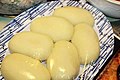 Fufu
Fufu -
 Pounding of fufu
 -
 Eating together as a family
 -
 Fufu
Fufu -
 Fufu with palm nut soup
 -
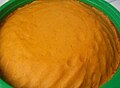 Fufu
Fufu -
 Nigerian food fufu
 -
Fufu
-
 Preparing the fufu
 -
 Wooden pestle and mortar
 -
 Fufu machine used by a food vendor
 -
 Pounded fufu


