Membrane potential: Difference between revisions
CSV import Tags: mobile edit mobile web edit |
CSV import |
||
| Line 13: | Line 13: | ||
{{stub}} | {{stub}} | ||
{{dictionary-stub1}} | {{dictionary-stub1}} | ||
<gallery> | |||
File:Basis_of_Membrane_Potential2-en.svg|Basis of Membrane Potential | |||
File:Electric_dipole.PNG|Electric Dipole | |||
File:Diffusion.en.svg|Diffusion | |||
File:Cell_membrane_detailed_diagram_en.svg|Cell Membrane Detailed Diagram | |||
File:Scheme_facilitated_diffusion_in_cell_membrane-en.svg|Scheme of Facilitated Diffusion in Cell Membrane | |||
File:Scheme_sodium-potassium_pump-en.svg|Scheme of Sodium-Potassium Pump | |||
File:Action_potential_ion_sizes.svg|Action Potential Ion Sizes | |||
File:Potassium_channel1.png|Potassium Channel | |||
File:LGIC.png|Ligand-Gated Ion Channel | |||
File:Cell_membrane_equivalent_circuit.svg|Cell Membrane Equivalent Circuit | |||
File:Cell_membrane_reduced_circuit.svg|Cell Membrane Reduced Circuit | |||
File:IPSPsummation.JPG|IPSP Summation | |||
</gallery> | |||
Latest revision as of 11:41, 18 February 2025
Membrane potential is the difference in electric potential between the interior and the exterior of a biological cell. With respect to the exterior of the cell, typical values of membrane potential, normally given in millivolts, range from –40 mV to –80 mV.
All animal cells are surrounded by a membrane composed of a lipid bilayer with proteins embedded in it. The membrane serves to separate and protect a cell from its surrounding environment and is made mostly from a double layer of phospholipids, hence the name lipid bilayer. The phospholipids that make up the lion's share of the lipid bilayer are amphipathic or dual-loving, with a hydrophilic or water-loving head and a hydrophobic or water-fearing tail.
The membrane potential has two basic functions. First, it allows a cell to function as a battery, providing power to operate a variety of "molecular devices" embedded in the membrane. Second, in electrically excitable cells such as neurons and muscle cells, it is used for transmitting signals between different parts of a cell. Signals are generated by opening or closing of ion channels at one point in the membrane, producing a local change in the membrane potential. This change in the membrane potential will raise or lower the probability that a nearby channel will open, thus enabling transmission of the signal.
 | |
|---|---|
 |
 |
-
 Basis of Membrane Potential
 -
 Electric Dipole
 -
 Diffusion
 -
 Cell Membrane Detailed Diagram
 -
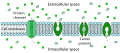 Scheme of Facilitated Diffusion in Cell Membrane
 -
 Scheme of Sodium-Potassium Pump
 -
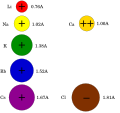 Action Potential Ion Sizes
 -
 Potassium Channel
 -
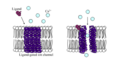 Ligand-Gated Ion Channel
 -
 Cell Membrane Equivalent Circuit
 -
 Cell Membrane Reduced Circuit
 -
 IPSP Summation


