Kenelm Digby: Difference between revisions
CSV import |
CSV import Tags: mobile edit mobile web edit |
||
| Line 31: | Line 31: | ||
[[Category:English scientists]] | [[Category:English scientists]] | ||
{{food-stub}} | {{food-stub}} | ||
<gallery> | |||
File:Sir_Kenelm_Digby_by_Sir_Anthony_Van_Dyck.jpg|Portrait of Sir Kenelm Digby by Sir Anthony Van Dyck | |||
File:Workshop_of_Anthony_van_Dyck_-_Portrait_of_Sir_Kenelm_Digby_with_a_Sunflower.jpg|Portrait of Sir Kenelm Digby with a Sunflower | |||
File:Van_Dyck,_Sir_Anthony_-_Venetia,_Lady_Digby,_on_her_Deathbed_-_Google_Art_Project.jpg|Venetia, Lady Digby, on her Deathbed | |||
File:Anthony_van_Dyck_-_Family_portrait_of_Sir_Kenelm_Digby_and_Lady_Venetia_Anastasia_Stanley_with_their_sons_Kenelm_and_John.jpg|Family portrait of Sir Kenelm Digby and Lady Venetia Anastasia Stanley with their sons Kenelm and John | |||
File:Aedes_Althorpianae,_or,_An_account_of_the_mansion,_books,_and_pictures_of_Althorp_-_the_residence_of_George_John_Earl_Spencer_to_which_is_added_a_supplement_to_the_Bibliotheca_Spenceriana_(1822)_(14779614345).jpg|Kenelm Digby | |||
File:Kenelm_Digby_1667_Discours_sur_la_vegetation_des_plantes.jpg|Kenelm Digby 1667 Discours sur la vegetation des plantes | |||
File:Alchemy-Digby-RareSecrets.png|Alchemy Digby Rare Secrets | |||
</gallery> | |||
Latest revision as of 11:36, 18 February 2025
Kenelm Digby (11 July 1603 – 11 June 1665) was an English courtier and diplomat. He was also a highly reputed natural philosopher, and known as a leading Roman Catholic intellectual and Blackloist. For his versatility, he is described in John Pointer's Oxoniensis Academia (1749) as the "Magazine of all Arts and Sciences, or the Ornament of this Nation".
Early Life[edit]
Digby was born in 1603 at Gayhurst, Buckinghamshire, England. He was of gentry stock, but his family's adherence to Roman Catholicism coloured his career. His father, Sir Everard, was executed in 1606 for his part in the Gunpowder Plot.
Career[edit]
In 1620, Digby married Venetia Stanley, whose wooing he cryptically described in his memoirs. He had also become a member of the Privy Council of England. He was knighted and in 1622, and in 1623, he was imprisoned in connection with the Spanish Match. He then became a privateer, or pirate, operating from Scilly.
Later Life and Death[edit]
In his later years, Digby became a noted neo-scholastic philosopher and experimented in the natural sciences. He is known for the publication of a cookbook, The Closet of the Eminently Learned Sir Kenelme Digbie Kt. Opened. Digby died in 1665 and is buried in the Christ Church, Oxford.
Legacy[edit]
Digby is known for his contributions to various fields. In literature, he is a character in many works, such as in the novel The Alchemist by Donna Woolfolk Cross. In science, the Kenelm Digby is named after him.
See Also[edit]
References[edit]
- The Closet of the Eminently Learned Sir Kenelme Digbie Kt. Opened (1669)
- Private Memoirs of Sir Kenelm Digby, With Castrations from the Lose Papers of Anthony à Wood (1827)
External Links[edit]

-
 Portrait of Sir Kenelm Digby by Sir Anthony Van Dyck
 -
 Portrait of Sir Kenelm Digby with a Sunflower
 -
 Venetia, Lady Digby, on her Deathbed
 -
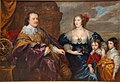 Family portrait of Sir Kenelm Digby and Lady Venetia Anastasia Stanley with their sons Kenelm and John
 -
 Kenelm Digby
 -
 Kenelm Digby 1667 Discours sur la vegetation des plantes
 -
 Alchemy Digby Rare Secrets


_(14779614345).jpg)


