Palladium(II) chloride: Difference between revisions
CSV import |
CSV import |
||
| Line 29: | Line 29: | ||
[[Category:Palladium compounds]] | [[Category:Palladium compounds]] | ||
{{Chem-stub}} | {{Chem-stub}} | ||
<gallery> | |||
File:Palladium_chloride.jpg|Palladium(II) chloride | |||
File:Palladium(II)-chloride-3D-vdW.png|Palladium(II) chloride 3D van der Waals model | |||
File:Palladium(II)-chloride-3D-balls.png|Palladium(II) chloride 3D ball model | |||
File:Beta-PdCl2.png|Beta form of Palladium(II) chloride | |||
File:Alpha-palladium(II)-chloride-xtal-3D-balls.png|Alpha form of Palladium(II) chloride crystal 3D ball model | |||
File:Pd6Cl12-from-xtal-1996-CM-3D-ellipsoids.png|Pd6Cl12 from crystal 1996 CM 3D ellipsoids | |||
File:Tetrachloropalladate_ions_in_aqueous_solution.jpg|Tetrachloropalladate ions in aqueous solution | |||
</gallery> | |||
Latest revision as of 11:35, 18 February 2025
Palladium(II) chloride, also known as palladium dichloride and palladium chloride, is a chemical compound with the formula PdCl2. It is a common source of palladium in the laboratory and in industrial processes, often used in catalysis, material science, and the synthesis of organic compounds. This compound is a key material in the field of coordination chemistry due to its ability to form complexes with a wide range of ligands.
Properties[edit]
Palladium(II) chloride is a brownish-red powder that is soluble in water, concentrated hydrochloric acid, and aqua regia. It forms a variety of complexes with many organic ligands, most notably in the Suzuki coupling, a widely used reaction in organic synthesis. The compound can absorb a large amount of hydrogen, which is reversible, making it useful in hydrogen storage applications.
Synthesis[edit]
Palladium(II) chloride is typically prepared by the reaction of palladium metal with chlorine. This process involves heating palladium sponge in the presence of chlorine gas at about 500°C. The reaction can also be performed by dissolving palladium metal in aqua regia, followed by evaporation and heating of the residue.
Applications[edit]
Catalysis[edit]
Palladium(II) chloride is extensively used as a catalyst in organic synthesis. It is a key component in the Suzuki coupling reaction, which is used to synthesize biphenyls, an important class of organic compounds in pharmaceuticals and organic materials. Additionally, it is used in the Wacker process, a method for the oxidation of ethylene to acetaldehyde.
Material Science[edit]
In material science, palladium(II) chloride is used in the preparation of palladium-based materials with applications in photocatalysis and as sensors. Its ability to form complexes with a variety of ligands allows for the synthesis of diverse palladium materials.
Other Uses[edit]
Palladium(II) chloride is also used in the purification and extraction of palladium from ores and recycled materials. Its solutions are employed in electroplating and as a source of palladium ions for various chemical processes.
Safety[edit]
Palladium(II) chloride is considered harmful if swallowed and causes severe skin burns and eye damage upon contact. Appropriate safety measures, including the use of personal protective equipment, are essential when handling this compound.
See Also[edit]

-
 Palladium(II) chloride
 -
 Palladium(II) chloride 3D van der Waals model
 -
 Palladium(II) chloride 3D ball model
 -
 Beta form of Palladium(II) chloride
 -
 Alpha form of Palladium(II) chloride crystal 3D ball model
 -
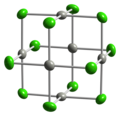 Pd6Cl12 from crystal 1996 CM 3D ellipsoids
 -
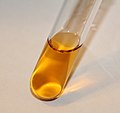 Tetrachloropalladate ions in aqueous solution

-chloride-3D-vdW.png)
-chloride-3D-balls.png)

-chloride-xtal-3D-balls.png)


