Cerbera odollam: Difference between revisions
CSV import |
CSV import |
||
| Line 28: | Line 28: | ||
[[Category:Medicinal plants of Asia]] | [[Category:Medicinal plants of Asia]] | ||
{{medicine-stub}} | {{medicine-stub}} | ||
<gallery> | |||
File:Cerbera_odollam_08718.jpg|Cerbera odollam | |||
File:Cerbera_manghas_-_Köhler–s_Medizinal-Pflanzen-175.jpg|Cerbera manghas illustration | |||
File:Cerbera_odollam_fruits,_flower,_and_leaves,_Dededo,_Guam.jpg|Cerbera odollam fruits, flower, and leaves, Dededo, Guam | |||
File:Pong_pong_tree_5.jpg|Pong pong tree | |||
File:Cerbera_odollam.jpg|Cerbera odollam | |||
File:Cerbera_odollam_07637.JPG|Cerbera odollam | |||
File:Cerbera_odollam_fruit_and_seedling._Dededo,_Guam.jpg|Cerbera odollam fruit and seedling, Dededo, Guam | |||
</gallery> | |||
Latest revision as of 11:34, 18 February 2025
Cerbera odollam, commonly known as the suicide tree, is a species of tree in the family Apocynaceae. It is native to India and other parts of southern Asia, where it grows in coastal salt swamps and marshy areas. The tree is notorious for its toxic seeds, which contain cerberin, a potent cardiac glycoside that can cause fatal cardiac arrest.
Description[edit]
Cerbera odollam is a medium-sized tree that can reach heights of up to 10 meters. It has a thick, grey trunk and glossy, dark green leaves that are oval in shape and measure 5 to 15 cm in length. The tree produces white flowers with a yellow center, which are followed by large, green, oval-shaped fruits. Each fruit contains a single large seed.
Toxicity[edit]
The seeds of Cerbera odollam are highly toxic due to the presence of cerberin, a cardiac glycoside similar to digoxin. Cerberin inhibits the sodium-potassium ATPase pump, leading to an increase in intracellular calcium in cardiac cells, which can cause fatal cardiac arrhythmias. Symptoms of cerberin poisoning include nausea, vomiting, diarrhea, irregular heartbeat, and eventually, death due to cardiac arrest.
Uses[edit]
Despite its toxicity, Cerbera odollam has been used in traditional medicine in some cultures. The seeds, leaves, and bark of the tree have been used to treat various ailments, although such practices are dangerous due to the risk of poisoning. In some regions, the tree is also used for timber and as an ornamental plant.
Legal Status[edit]
Due to its potential for misuse, the cultivation, sale, and possession of Cerbera odollam are regulated in some countries. However, enforcement is challenging due to the tree's widespread occurrence in its native range.
Research[edit]
Research on Cerbera odollam has focused on understanding the mechanism of action of cerberin and investigating potential medical applications for cardiac glycosides. There is also interest in developing methods to detect cerberin poisoning, which can be difficult to diagnose.
See Also[edit]
References[edit]
<references/>

-
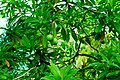 Cerbera odollam
 -
 Cerbera manghas illustration
 -
 Cerbera odollam fruits, flower, and leaves, Dededo, Guam
 -
 Pong pong tree
 -
 Cerbera odollam
 -
 Cerbera odollam
 -
 Cerbera odollam fruit and seedling, Dededo, Guam


