Early modern European cuisine: Difference between revisions
CSV import |
CSV import |
||
| Line 43: | Line 43: | ||
[[Category:Early Modern period]] | [[Category:Early Modern period]] | ||
[[Category:Culinary history]] | [[Category:Culinary history]] | ||
<gallery> | |||
File:CLAESZ_Still_life_with_a_peacock_pie.jpg|Still life with a peacock pie | |||
File:Pieter_Aertsen_Peasants_by_the_Hearth.jpg|Peasants by the Hearth | |||
File:Pieter_Bruegel_the_Elder-_The_Harvesters_-_Google_Art_Project.jpg|The Harvesters | |||
File:A_Meat_Stall_with_the_Holy_Family_Giving_Alms_-_Pieter_Aertsen_-_Google_Cultural_Institute.jpg|A Meat Stall with the Holy Family Giving Alms | |||
File:Ca'_Rezzonico_-_La_cioccolata_del_mattino_-_Pietro_Longhi.jpg|La cioccolata del mattino | |||
File:Carracci_-_Der_Bohnenesser.jpeg|Der Bohnenesser | |||
</gallery> | |||
Latest revision as of 11:34, 18 February 2025
Early Modern European Cuisine[edit]
Early Modern European cuisine refers to the culinary practices and food culture that emerged in Europe during the Early Modern period, spanning from the 15th to the 18th century. This period witnessed significant changes in European society, including exploration, colonization, and the rise of the Renaissance and Enlightenment movements. These developments greatly influenced the culinary traditions and ingredients used in European cooking.
Influences[edit]
Early Modern European cuisine was shaped by a variety of influences, including trade, exploration, and cultural exchange. The discovery of the New World brought new ingredients, such as potatoes, tomatoes, and chocolate, which were incorporated into European cooking. The spice trade with Asia also introduced a wide range of exotic spices, transforming the flavors of European dishes.
Regional Variations[edit]
Early Modern European cuisine varied across different regions of the continent. Each region had its own unique culinary traditions and local ingredients. For example, Mediterranean countries like Italy and Spain relied heavily on olive oil, seafood, and fresh produce, while Northern European countries like England and Germany focused more on meat, dairy products, and root vegetables.
Popular Dishes[edit]
During the Early Modern period, certain dishes became popular across Europe. Some of these dishes included:
1. Pot-au-feu: A French stew made with various cuts of meat, vegetables, and spices. 2. Pottage: A thick soup made with vegetables, grains, and sometimes meat. 3. Roast meats: Roasted meats, such as beef, lamb, and poultry, were commonly served as main dishes. 4. Pies: Pies filled with meat, fish, or vegetables were a staple in many European cuisines. 5. Porridge: A simple dish made by boiling grains, such as oats or barley, in water or milk.
Culinary Techniques[edit]
Early Modern European cuisine saw the development of various culinary techniques. These techniques included roasting, boiling, baking, and frying. The use of spices and herbs to enhance flavors also became more prevalent during this period. Additionally, the introduction of new cooking utensils, such as the fork and the oven, revolutionized the way food was prepared and served.
Legacy[edit]
Many of the culinary traditions and dishes that originated during the Early Modern period continue to be enjoyed today. European cuisines, such as French, Italian, and Spanish, still incorporate many of the ingredients and techniques that were popular during this time. The exploration and exchange of culinary ideas during this period laid the foundation for the diverse and rich food culture that exists in Europe today.
See Also[edit]
References[edit]
<references />
-
 Still life with a peacock pie
 -
 Peasants by the Hearth
 -
 The Harvesters
 -
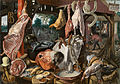 A Meat Stall with the Holy Family Giving Alms
 -
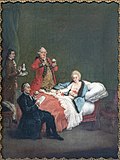 La cioccolata del mattino
 -
 Der Bohnenesser


