Carroll rearrangement: Difference between revisions
CSV import |
CSV import |
||
| Line 28: | Line 28: | ||
{{Chemistry-stub}} | {{Chemistry-stub}} | ||
<gallery> | |||
File:LinaloolToGeranylacetone.svg|Linalool to Geranylacetone reaction | |||
File:Carrol_rearrangement_reaction_mechanism.png|Carroll rearrangement reaction mechanism | |||
File:Decarboxylative_allylation_mechanistic.png|Decarboxylative allylation mechanism | |||
File:AsymmetricCarrol2005.png|Asymmetric Carroll rearrangement 2005 | |||
File:AsymmetricCarrolRearrangement.png|Asymmetric Carroll rearrangement | |||
File:DecarboxylativeAllylation.png|Decarboxylative allylation | |||
File:DecarboxylativeAllylationTrost2005.png|Decarboxylative allylation Trost 2005 | |||
</gallery> | |||
Latest revision as of 11:34, 18 February 2025
Carroll Rearrangement is a chemical reaction that involves the rearrangement of a glycol into an aldehyde or ketone. This reaction is significant in organic chemistry for the synthesis of various carbonyl compounds from more readily available glycol substances. The process is named after the chemist who first reported it, and it has since become a valuable tool in the synthesis of complex molecules, particularly in the fields of pharmaceuticals and fine chemicals.
Overview[edit]
The Carroll Rearrangement is a thermal rearrangement reaction, meaning it requires the application of heat to proceed. The reaction mechanism involves the intramolecular migration of an alkyl or aryl group from one oxygen atom to another within a glycol molecule, leading to the formation of a carbonyl compound. This rearrangement is particularly useful for synthesizing aldehydes and ketones from 1,2-diols or vicinal diols, which are glycols with two hydroxyl groups on adjacent carbon atoms.
Mechanism[edit]
The mechanism of the Carroll Rearrangement begins with the protonation of one of the hydroxyl groups in the glycol, followed by the loss of water to form an oxonium ion. This intermediate then undergoes a 1,2-alkyl shift, transferring an alkyl or aryl group from one oxygen to the other. The rearrangement concludes with the deprotonation of the oxonium ion to yield the final carbonyl product. The reaction is facilitated by the application of heat, which helps overcome the energy barrier associated with the rearrangement process.
Applications[edit]
The Carroll Rearrangement has found applications in various areas of organic synthesis. It is particularly useful in the synthesis of complex molecules, such as natural products and pharmaceuticals, where the selective introduction of carbonyl functionalities is required. The reaction's ability to convert readily available glycols into valuable aldehydes and ketones makes it a powerful tool in the chemist's arsenal.
Limitations[edit]
While the Carroll Rearrangement is a versatile and useful reaction, it does have limitations. The requirement for heat can sometimes lead to the decomposition of sensitive substrates or the formation of unwanted by-products. Additionally, the reaction's selectivity can be influenced by the nature of the substituents on the glycol, sometimes leading to a mixture of products.
See Also[edit]
References[edit]
<references/>

-
 Linalool to Geranylacetone reaction
 -
 Carroll rearrangement reaction mechanism
 -
 Decarboxylative allylation mechanism
 -
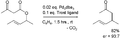 Asymmetric Carroll rearrangement 2005
 -
 Asymmetric Carroll rearrangement
 -
 Decarboxylative allylation
 -
 Decarboxylative allylation Trost 2005


