CBRN defense: Difference between revisions
CSV import |
CSV import |
||
| Line 37: | Line 37: | ||
{{stub}} | {{stub}} | ||
<gallery> | |||
File:US_Navy_040117-N-0331L-023_Nuclear,_Biological,_and_Chemical_(NBC)_disposal_technicians_from_the_1st_Marines_1st_Battalion_prepare_to_search_the_Military_Sealift_Command_(MSC)_combat_stores_ship_USNS_Saturn_(T-AFS_10).jpg|NBC disposal technicians prepare to search USNS Saturn | |||
File:Exercício_Integrado_de_respostas_em_desastres_naturais_e_antropogênicos_(23386333032).jpg|Integrated disaster response exercise | |||
File:HAZMAT_incident_Toronto.jpg|HAZMAT incident in Toronto | |||
File:EOD_Exercise_Dublin_Port_(5475152518).jpg|EOD Exercise at Dublin Port | |||
File:U.S._Marines_Training_Exercise_for_Temporary_Critical_Support_to_Enable_Community_Recovery_after_a_CBRNE_Incident.jpg|U.S. Marines training for CBRNE incident recovery | |||
File:US_Navy_050615-N-8148A-063_The_Nimitz-class_aircraft_carrier_USS_Ronald_Reagan_(CVN_76)_activates_her_countermeasures_wash_down_system_as_part_of_a_series_of_test_and_evaluations_to_certify_the_vessel_in_the_event_of_a_chemical.jpg|USS Ronald Reagan activates countermeasures wash down system | |||
</gallery> | |||
Latest revision as of 11:33, 18 February 2025
CBRN defense or Chemical, Biological, Radiological and Nuclear defense is the protective measures taken in situations where chemical, biological, radiological, and nuclear hazards may be present. CBRN defense aims to prevent or mitigate the effects of exposure to hazardous substances that can cause significant harm to individuals, communities, and the environment. This article provides an overview of the components, strategies, and challenges associated with CBRN defense.
Overview[edit]
CBRN defense encompasses a wide range of activities and technologies designed to protect against the threats posed by chemical, biological, radiological, and nuclear materials. These threats can arise from military conflicts, industrial accidents, or terrorist attacks. The primary goals of CBRN defense are to detect, identify, protect against, and decontaminate hazardous substances, as well as to manage and treat casualties.
Components[edit]
CBRN defense can be divided into several key components:
Detection[edit]
Detection involves the identification of CBRN materials through the use of sensors and monitoring equipment. This can include the detection of chemical warfare agents, biological warfare agents, radiation, and nuclear materials. Early detection is critical for effective response and mitigation.
Protection[edit]
Protection measures are designed to shield individuals and populations from the effects of CBRN materials. This can include personal protective equipment (PPE) such as gas masks and protective suits, as well as collective protection in the form of shelters and air filtration systems.
Decontamination[edit]
Decontamination involves the removal or neutralization of CBRN materials from individuals, equipment, and environments. This can be achieved through physical, chemical, or biological means, depending on the nature of the contaminant.
Medical Countermeasures[edit]
Medical countermeasures include the use of vaccines, antidotes, and other treatments to prevent or mitigate the health effects of exposure to CBRN materials. This also encompasses medical response and casualty management strategies.
Strategies[edit]
Effective CBRN defense requires a comprehensive approach that integrates various strategies:
- Preparedness: Developing plans and conducting training exercises to ensure readiness for CBRN incidents.
- Response: Implementing immediate actions to protect lives and contain hazards in the event of a CBRN incident.
- Recovery: Restoring affected areas and returning them to safe use following a CBRN incident.
Challenges[edit]
CBRN defense faces several challenges, including the evolving nature of threats, the difficulty of detecting and identifying CBRN materials, and the need for specialized training and equipment. Additionally, the psychological impact of CBRN incidents on populations and responders can complicate response efforts.
Conclusion[edit]
CBRN defense is a critical component of national and international security efforts. Through the integration of detection, protection, decontamination, and medical countermeasures, CBRN defense aims to mitigate the risks and impacts of chemical, biological, radiological, and nuclear hazards.
 | |
|---|---|
 |
 |
-
 NBC disposal technicians prepare to search USNS Saturn
 -
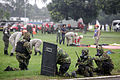 Integrated disaster response exercise
 -
 HAZMAT incident in Toronto
 -
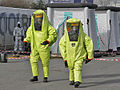 EOD Exercise at Dublin Port
 -
 U.S. Marines training for CBRNE incident recovery
 -
 USS Ronald Reagan activates countermeasures wash down system
_disposal_technicians_from_the_1st_Marines_1st_Battalion_prepare_to_search_the_Military_Sealift_Command_(MSC)_combat_stores_ship_USNS_Saturn_(T-AFS_10).jpg)
.jpg)

.jpg)

_activates_her_countermeasures_wash_down_system_as_part_of_a_series_of_test_and_evaluations_to_certify_the_vessel_in_the_event_of_a_chemical.jpg)
