Trisomy X: Difference between revisions
CSV import |
CSV import |
||
| Line 50: | Line 50: | ||
[[Category:Genetic disorders]] | [[Category:Genetic disorders]] | ||
[[Category:Chromosomal abnormalities]] | [[Category:Chromosomal abnormalities]] | ||
<gallery> | |||
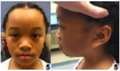
File:Trisomy_X_facial_phenotypes_(cropped).png|Trisomy X facial phenotypes | |||
File:Estimated_Full-Scale_IQ_(FSIQ)_distribution_for_females_with_47,XXX_compared_to_controls.png|Estimated Full-Scale IQ (FSIQ) distribution for females with 47,XXX compared to controls | |||
File:45,X0-47,XXX_mosaic.png|45,X0-47,XXX mosaic | |||
File:2-Karyotype-showing-46-XX-and-46-XXX.jpg|Karyotype showing 46,XX and 46,XXX | |||
File:SCA_expected_and_observed_prevalence_in_Denmark_-_cropped_to_TS_and_TX.png|SCA expected and observed prevalence in Denmark | |||
File:KS-TX-YY_age_at_diagnosis.png|KS, TX, YY age at diagnosis | |||
</gallery> | |||
Revision as of 11:33, 18 February 2025
Trisomy X
.png)
Trisomy X, also known as 47,XXX, is a chromosomal disorder that affects females. It is characterized by the presence of an extra X chromosome, resulting in a total of three X chromosomes instead of the usual two. This condition occurs in approximately 1 in 1,000 female births.
Genetics
Trisomy X is caused by nondisjunction during meiosis, which leads to an extra X chromosome in each cell. The karyotype for Trisomy X is 47,XXX. In some cases, mosaicism can occur, where some cells have the typical 46,XX karyotype and others have 47,XXX.

Clinical Features
Many females with Trisomy X are asymptomatic and may never be diagnosed. However, some may exhibit mild symptoms such as tall stature, learning disabilities, and delayed speech and language development. Behavioral and emotional difficulties can also occur.
_distribution_for_females_with_47,XXX_compared_to_controls.png)
Diagnosis
Trisomy X is often diagnosed through a karyotype analysis, which can be performed prenatally or postnatally. Prenatal diagnosis is possible through procedures such as amniocentesis or chorionic villus sampling.
Epidemiology
The prevalence of Trisomy X is estimated to be around 1 in 1,000 female births. However, due to the often mild or asymptomatic nature of the condition, many cases remain undiagnosed.

Management
Management of Trisomy X is typically supportive and symptomatic. Educational support and speech therapy may be beneficial for those with learning disabilities or speech delays. Regular monitoring and follow-up with healthcare providers are recommended.
Prognosis
The prognosis for individuals with Trisomy X is generally good, with most leading normal lives. Lifespan is not significantly affected, and many women with Trisomy X have normal fertility.
Related Pages

References
- Tartaglia, N. R., Howell, S., Sutherland, A., Wilson, R., & Wilson, L. (2010). A review of trisomy X (47,XXX). Orphanet Journal of Rare Diseases, 5(1), 8.
- Leggett, V., Jacobs, P., Nation, K., Scerif, G., & Bishop, D. V. M. (2010). Neurocognitive outcomes of individuals with a sex chromosome trisomy: XXX, XYY, or XXY: A systematic review. Developmental Medicine & Child Neurology, 52(2), 119-129.
-
 Trisomy X facial phenotypes
 -
 Estimated Full-Scale IQ (FSIQ) distribution for females with 47,XXX compared to controls
 -
 45,X0-47,XXX mosaic
 -
 Karyotype showing 46,XX and 46,XXX
 -
 SCA expected and observed prevalence in Denmark
 -
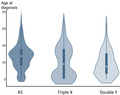 KS, TX, YY age at diagnosis

