Kauri gum: Difference between revisions
CSV import |
CSV import |
||
| Line 32: | Line 32: | ||
[[Category:History of New Zealand]] | [[Category:History of New Zealand]] | ||
[[Category:Agathis]] | [[Category:Agathis]] | ||
<gallery> | |||
File:Kauri_gum_carving.jpg|Kauri gum carving | |||
File:Kauri_gum_polished_side.jpg|Polished side of Kauri gum | |||
File:Kauri_gum_unpolished_side.jpg|Unpolished side of Kauri gum | |||
File:Kauri_at_Waipoua_Forest.jpg|Kauri at Waipoua Forest | |||
File:Dargaville_gumdigger.jpg|Dargaville gumdigger | |||
File:Group_of_gum_diggers_in_gumfield_(1908).jpg|Group of gum diggers in gumfield (1908) | |||
File:North_Auckland_Kauri_Forest_Lantern_Slide_c1890_-_c1910_(17832403125).jpg|North Auckland Kauri Forest Lantern Slide c1890 - c1910 | |||
</gallery> | |||
Latest revision as of 11:33, 18 February 2025
Kauri gum is a type of fossilized resin detracted from kauri trees (Agathis australis), which are found predominantly in the northern region of New Zealand. The gum was used extensively during the 19th and early 20th centuries and has played a significant role in New Zealand's economic history.
History[edit]
The use of Kauri gum dates back to the Māori, the indigenous people of New Zealand, who used it both as a fire starter and for the creation of tools and jewelry. With the arrival of European settlers in the 19th century, the gum was harvested extensively for use in varnishes and linoleum. The gum was collected through a variety of methods, including digging it out of the ground and climbing trees to retrieve it.
Economic Impact[edit]
The Kauri gum industry reached its peak in the late 19th century, becoming one of New Zealand's major export goods. The industry declined in the early 20th century due to the development of synthetic substitutes and the depletion of gum resources. Today, kauri gum is a sought-after collector's item, and pieces are often used in jewelry and other decorative items.
Collection and Processing[edit]
Kauri gum was collected by both Māori and European settlers. The gum was often found on the ground, but could also be retrieved from the bark or trunk of the kauri tree. Once collected, the gum was cleaned and graded before being exported or used domestically.
Uses[edit]
In addition to its use in varnishes and linoleum, Kauri gum was also used in the production of photographic film, and as a binder in paint. Today, it is primarily used in the creation of jewelry and other decorative items.
See Also[edit]
| Economy of New Zealand | ||||||||||
|---|---|---|---|---|---|---|---|---|---|---|
|
| History of New Zealand |
|---|
 |
| Timeline |
| General topics |
| Prior to 1800 |
| 19th century |
| Stages of independence |
| World Wars |
| Post-war and contemporary history |
|
| See also |

-
 Kauri gum carving
 -
 Polished side of Kauri gum
 -
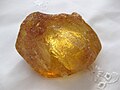 Unpolished side of Kauri gum
 -
 Kauri at Waipoua Forest
 -
 Dargaville gumdigger
 -
 Group of gum diggers in gumfield (1908)
 -
 North Auckland Kauri Forest Lantern Slide c1890 - c1910


.jpg)
.jpg)
