Palisaded encapsulated neuroma: Difference between revisions
CSV import |
CSV import |
||
| Line 29: | Line 29: | ||
[[Category:Pathology]] | [[Category:Pathology]] | ||
{{medicine-stub}} | {{medicine-stub}} | ||
<gallery> | |||
File:Palisaded_and_Encapsulated_Neuroma_(3953412330).jpg|Palisaded encapsulated neuroma | |||
File:Palisaded_and_Encapsulated_Neuroma_(978575618).jpg|Palisaded encapsulated neuroma | |||
File:Palisaded_and_Encapsulated_Neuroma_(3952635881).jpg|Palisaded encapsulated neuroma | |||
File:Palisaded_and_Encapsulated_Neuroma,_S-100_Immunostain_(3953412396).jpg|Palisaded encapsulated neuroma, S-100 immunostain | |||
File:Skin_Tumors-PA291040.jpg|Palisaded encapsulated neuroma | |||
File:Skin_Tumors-PA291039.jpg|Palisaded encapsulated neuroma | |||
</gallery> | |||
Revision as of 11:31, 18 February 2025
Palisaded Encapsulated Neuroma (PEN) is a benign cutaneous condition characterized by a solitary, firm, skin-colored or pink nodule, typically occurring on the face, particularly the nose. It is a non-cancerous growth that arises from the peripheral nerves and is composed of Schwann cells, fibroblasts, and perineural cells. Despite its benign nature, it can sometimes be mistaken for malignant tumors, such as basal cell carcinoma or malignant melanoma, due to its appearance.
Etiology and Pathogenesis
The exact cause of Palisaded Encapsulated Neuroma is unknown. It is considered to be a reactive process rather than a true neoplasm. Trauma or a history of minor injuries to the affected area has been suggested as a possible trigger for the development of PEN. Histologically, it is characterized by a well-circumscribed nodule composed of spindle-shaped Schwann cells arranged in a palisaded pattern. These cells are surrounded by a fibrous capsule, which is where the term "encapsulated" in its name comes from.
Clinical Features
Palisaded Encapsulated Neuroma typically presents as a solitary, asymptomatic, skin-colored or pink nodule. The size of the lesion usually ranges from 2 to 6 mm in diameter. It is most commonly located on the face, especially on the nose, but can also appear on other parts of the body such as the neck, trunk, and extremities. PEN does not usually cause any symptoms, but some patients may experience tenderness upon palpation.
Diagnosis
The diagnosis of Palisaded Encapsulated Neuroma is primarily based on histopathological examination. Dermoscopy can be a useful non-invasive tool in the initial assessment, but a definitive diagnosis requires a biopsy of the lesion. Histologically, PEN is distinguished by its well-defined capsule and the presence of Schwann cells arranged in a palisaded pattern around axons, without atypia or mitotic figures.
Differential Diagnosis
The differential diagnosis for Palisaded Encapsulated Neuroma includes several other cutaneous lesions such as neurofibroma, schwannoma, and various skin cancers. Clinical and histopathological evaluation is essential to differentiate PEN from these conditions.
Treatment
Since Palisaded Encapsulated Neuroma is a benign lesion, treatment is not always necessary unless for cosmetic reasons or if the lesion is symptomatic. Surgical excision is the most common treatment method and is usually curative. Recurrence after complete excision is rare.
Prognosis
The prognosis for Palisaded Encapsulated Neuroma is excellent, as it is a benign lesion with no malignant potential. Surgical removal is curative in most cases, and recurrence is uncommon.
Epidemiology
Palisaded Encapsulated Neuroma can occur at any age but is most commonly diagnosed in adults. There is no known gender predilection. The prevalence of PEN is not well documented, as many cases may go unrecognized or misdiagnosed.
Conclusion
Palisaded Encapsulated Neuroma is a benign peripheral nerve sheath tumor that typically presents as a solitary, asymptomatic nodule on the face. Despite its benign nature, accurate diagnosis through histopathological examination is crucial to differentiate it from other cutaneous lesions, including malignant tumors. Surgical excision is the treatment of choice and is usually curative.
 | This medical article is a stub. You can help Wikipedia by adding missing information. |
-
 Palisaded encapsulated neuroma
 -
 Palisaded encapsulated neuroma
 -
 Palisaded encapsulated neuroma
 -
 Palisaded encapsulated neuroma, S-100 immunostain
 -
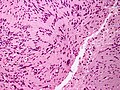 Palisaded encapsulated neuroma
 -
 Palisaded encapsulated neuroma
.jpg)
.jpg)
.jpg)
.jpg)


