Lasers and aviation safety: Difference between revisions
CSV import Tags: mobile edit mobile web edit |
CSV import |
||
| Line 34: | Line 34: | ||
{{aviation-stub}} | {{aviation-stub}} | ||
{{technology-stub}} | {{technology-stub}} | ||
<gallery> | |||
File:Light_Amplification_by_Stimulated_Emission_of_Radiation.jpg|Light Amplification by Stimulated Emission of Radiation | |||
File:Runway_distraction_anim.gif|Runway Distraction Animation | |||
File:Runway_glare_anim.gif|Runway Glare Animation | |||
File:Runway_flashblindness_anim.gif|Runway Flashblindness Animation | |||
File:Laser_pointer_safety_distances.svg|Laser Pointer Safety Distances | |||
File:FAA_laser-free-zone.svg|FAA Laser-Free Zone | |||
File:FAA_airspace-flight-zones.svg|FAA Airspace Flight Zones | |||
</gallery> | |||
Latest revision as of 11:30, 18 February 2025
Lasers and Aviation Safety is a topic that encompasses the use of laser technology in the field of aviation to enhance safety measures. The use of lasers in aviation safety has been a significant development, providing solutions to various challenges in the industry.
Overview[edit]
Lasers are devices that emit light through a process of optical amplification based on the stimulated emission of electromagnetic radiation. In the context of aviation, lasers are used in a variety of applications to enhance safety, including aircraft navigation, collision avoidance systems, and runway lighting.
[edit]
Laser-based navigation systems are used in aviation to provide precise navigation information to pilots. These systems use lasers to measure the distance between the aircraft and a fixed point on the ground, allowing for accurate determination of the aircraft's position and direction. This technology has significantly improved the safety of flight operations, particularly in challenging weather conditions or in areas with limited visibility.
Collision Avoidance Systems[edit]
Collision avoidance systems in aviation often utilize laser technology. These systems use laser beams to detect other aircraft or obstacles in the flight path, providing early warning to pilots and allowing them to take evasive action if necessary. This has greatly reduced the risk of mid-air collisions and has contributed to the overall safety of air travel.
Runway Lighting[edit]
Lasers are also used in runway lighting systems. These systems use laser lights to illuminate the runway, making it easier for pilots to see the runway during landing or takeoff. This is particularly useful in low-visibility conditions, such as fog or heavy rain.
Safety Concerns[edit]
While lasers have greatly improved aviation safety, they also pose some safety concerns. For example, unauthorized use of lasers can pose a threat to aviation safety. There have been incidents where lasers have been pointed at aircraft, potentially blinding pilots and causing serious safety risks. As a result, regulations have been put in place to prevent such incidents and ensure the safe use of lasers in aviation.
See Also[edit]


-
 Light Amplification by Stimulated Emission of Radiation
 -
 Runway Distraction Animation
 -
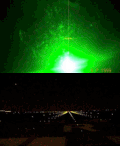 Runway Glare Animation
 -
 Runway Flashblindness Animation
 -
 Laser Pointer Safety Distances
 -
 FAA Laser-Free Zone
 -
 FAA Airspace Flight Zones


