Bothrops asper: Difference between revisions
CSV import |
CSV import |
||
| Line 47: | Line 47: | ||
[[Category:Reptiles of South America]] | [[Category:Reptiles of South America]] | ||
[[Category:Venomous snakes]] | [[Category:Venomous snakes]] | ||
<gallery> | |||
File:Bothrops_asper_170971120.jpg|Bothrops asper | |||
File:Bothrops_asper_(Panama).jpg|Bothrops asper in Panama | |||
File:Bothrops_asper_(Panama)_coiled.jpg|Coiled Bothrops asper in Panama | |||
File:Bothrops_asper_(Panama)_head.jpg|Head of Bothrops asper in Panama | |||
File:Young_Terciopelo_(Bothrops_asper)_found_on_the_coach_at_the_hotel_(6781403567).jpg|Young Terciopelo (Bothrops asper) found on the coach at the hotel | |||
File:Tissue_necrosis_following_bite_from_Bothrops_asper_PLoS_Medicine.jpg|Tissue necrosis following bite from Bothrops asper | |||
</gallery> | |||
Revision as of 11:30, 18 February 2025
Bothrops asper, commonly known as the terciopelo or fer-de-lance, is a highly venomous pit viper species found in Central and South America. It is one of the most dangerous snakes in its range due to its potent venom and aggressive behavior.
Description
Bothrops asper is a large snake, with adults typically ranging from 1.2 to 2.5 meters in length. The body is robust, with a distinctive triangular head that is wider than the neck. The coloration is variable, but it generally features a pattern of dark, diamond-shaped blotches along the back, which can provide excellent camouflage in its natural habitat.
Distribution and Habitat
This species is widely distributed from southern Mexico through Central America to northern South America, including Colombia, Venezuela, and Ecuador. Bothrops asper inhabits a variety of environments, from lowland tropical rainforests to dry forests and even agricultural areas. It is often found near water sources, such as rivers and streams.
Behavior
Bothrops asper is primarily nocturnal and terrestrial, although it can climb trees and swim well. It is known for its defensive behavior and will not hesitate to strike if threatened. This species is responsible for a significant number of snakebite incidents in its range.
Venom
The venom of Bothrops asper is highly toxic and contains a complex mixture of enzymes and proteins that can cause severe local and systemic effects. Envenomation can lead to pain, swelling, tissue necrosis, coagulopathy, and, in severe cases, death. Antivenom is available and is the primary treatment for bites.
Reproduction
Bothrops asper is ovoviviparous, meaning that females give birth to live young. A typical litter consists of 20 to 40 neonates, although larger litters have been reported. The young are independent from birth and are capable of hunting small prey.
Conservation Status
Currently, Bothrops asper is not considered to be at risk of extinction. It is a common species throughout its range and is adaptable to a variety of habitats, including disturbed areas.
Also see
.png)
-
 Bothrops asper
 -
 Bothrops asper in Panama
 -
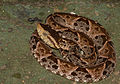 Coiled Bothrops asper in Panama
 -
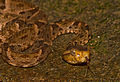 Head of Bothrops asper in Panama
 -
 Young Terciopelo (Bothrops asper) found on the coach at the hotel
 -
 Tissue necrosis following bite from Bothrops asper

.jpg)
_coiled.jpg)
_head.jpg)
_found_on_the_coach_at_the_hotel_(6781403567).jpg)

