Camp Letterman: Difference between revisions
CSV import |
CSV import |
||
| Line 17: | Line 17: | ||
Camp Letterman played a crucial role in the aftermath of the Battle of Gettysburg, providing medical aid to thousands of wounded soldiers. Its establishment marked a significant advancement in battlefield medicine and the care of injured soldiers during the Civil War.<br>{{hospital stub}} | Camp Letterman played a crucial role in the aftermath of the Battle of Gettysburg, providing medical aid to thousands of wounded soldiers. Its establishment marked a significant advancement in battlefield medicine and the care of injured soldiers during the Civil War.<br>{{hospital stub}} | ||
<gallery> | |||
File:After_the_battle_ended,_20,000_wounded_soldiers_were_cared_for_in_a_tent_hospital_at_Camp_Letterman._The_Tyson_Brothers_photographed_this_hospital_in_August_1863_LOC_9157937275.jpg|Camp Letterman | |||
File:Operating_Tent,_Camp_Letterman,_Gettysburg,_Pennsylvania_MET_DP254883.jpg|Operating Tent at Camp Letterman | |||
File:Cornelia_Hancock_civil_war_nurse.jpg|Cornelia Hancock, Civil War Nurse | |||
File:RebeccaLanePennypackerPrice1914a.jpg|Rebecca Lane Pennypacker Price | |||
File:Anna_Morris_Holstein.png|Anna Morris Holstein | |||
</gallery> | |||
Latest revision as of 11:28, 18 February 2025
{{This military structure related article is a stub.}}
Camp Letterman was a Union Army field hospital established near the Gettysburg Battlefield in Pennsylvania during the American Civil War. It was built in 1863 to provide medical care for the wounded soldiers of both the Union and Confederate armies after the Battle of Gettysburg in July of that year.
The Battle of Gettysburg, fought between the Union Army of the Potomac and the Confederate Army of Northern Virginia, was a significant turning point in the Civil War. The intense three-day battle resulted in heavy casualties on both sides, with over 14,000 Union and 6,800 Confederate soldiers wounded.<ref>Musto, R. J,
 The Treatment of the Wounded at Gettysburg: Jonathan Letterman: The Father of Modern Battlefield Medicine,
Gettysburg Magazine,</ref><ref>Atkinson, Matthew. "'War is a hellish way of settling a dispute": Dr. Jonathan Letterman and the Tortuous Path of Medical Care from Manassas to Camp Letterman," pp. 101-113, in "Gettysburg Seminars 2010.

" Washington, D.C.: U.S. National Park Service and Gettysburg, Pennsylvania: Gettysburg National Military Park, 2010.</ref>
Due to the overwhelming number of wounded soldiers and the inadequate facilities in Gettysburg, Union military leaders decided to establish a dedicated hospital. Camp Letterman was constructed on the George Wolf farm, east of Gettysburg, near the York Pike. It served as a general hospital, providing medical treatment and care for the injured soldiers.<ref>"History and Culture," in "Gettysburg National Military Park.
" Washington, D.C.: U.S. National Park Service, retrieved online August 8, 2019.</ref>
The hospital was named after Dr. Jonathan Letterman, who is considered the father of modern battlefield medicine. He revolutionized medical care during the Civil War by implementing a system of triage and organizing medical resources to provide efficient treatment to the wounded soldiers.<ref>Musto, R. J,
The Treatment of the Wounded at Gettysburg: Jonathan Letterman: The Father of Modern Battlefield Medicine, Gettysburg Magazine,</ref>
Camp Letterman played a crucial role in the aftermath of the Battle of Gettysburg, providing medical aid to thousands of wounded soldiers. Its establishment marked a significant advancement in battlefield medicine and the care of injured soldiers during the Civil War.
-
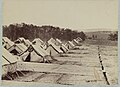 Camp Letterman
 -
 Operating Tent at Camp Letterman
 -
 Cornelia Hancock, Civil War Nurse
 -
 Rebecca Lane Pennypacker Price
 -
 Anna Morris Holstein


