Commercial offshore diving: Difference between revisions
CSV import |
CSV import |
||
| Line 38: | Line 38: | ||
{{Occupation-stub}} | {{Occupation-stub}} | ||
{{Maritime-stub}} | {{Maritime-stub}} | ||
<gallery> | |||
File:Commercial_diving_equipment_at_Eudi_Show_2006_adventurediving.it.jpg|Commercial diving equipment at Eudi Show 2006 | |||
File:SubmarinePipelinesConstruction_Laybarge&Towsystems.svg|Submarine Pipelines Construction Laybarge & Tow systems | |||
File:SubmarinePipelines_Posttrenching.svg|Submarine Pipelines Posttrenching | |||
File:Toisa_Polaris_p5_14January2007.jpg|Toisa Polaris | |||
File:Iremis_da_Vinci_at_the_Albert_Dock_Basin,_Port_of_Leith.jpg|Iremis da Vinci at the Albert Dock Basin, Port of Leith | |||
</gallery> | |||
Latest revision as of 11:28, 18 February 2025
Commercial offshore diving is a professional occupation that involves working underwater in offshore environments, such as oil and gas platforms, and underwater construction sites.
Overview[edit]
Commercial diving is a type of professional diving where divers are paid for their work. Offshore diving, a subset of commercial diving, specifically refers to diving operations carried out in the open ocean, often in relation to the exploration and extraction of oil and gas resources.
Types of Offshore Diving[edit]
There are three main types of offshore diving: Air diving, Saturation diving, and Closed Bell diving.
Air Diving[edit]
Air diving is the most common type of commercial diving, where divers breathe compressed air and work at depths of up to 50 meters.
Saturation Diving[edit]
In saturation diving, divers live in a pressurized environment for several days or even weeks. This allows them to work at greater depths for longer periods of time.
Closed Bell Diving[edit]
Closed bell diving, also known as lockout diving, involves the use of a diving bell that transports divers from the surface to the work site.
Risks and Safety[edit]
Commercial offshore diving is a high-risk occupation. Divers face numerous hazards including decompression sickness, hypothermia, and the risk of injury from underwater machinery or marine life. Safety measures such as Dive planning, Diver communications, and Emergency procedures are crucial in this field.
Training and Certification[edit]
Commercial offshore divers must undergo rigorous training and certification. This typically includes a commercial diving course accredited by a recognized body such as the International Marine Contractors Association (IMCA) or the Association of Diving Contractors International (ADCI).
Equipment[edit]
Commercial offshore diving requires specialized equipment, including Diving suits, Diving helmets, Underwater breathing apparatus, and Diving bells.
See Also[edit]
References[edit]
<references />

This maritime related article is a stub. You can help WikiMD by expanding it.
-
 Commercial diving equipment at Eudi Show 2006
 -
 Submarine Pipelines Construction Laybarge & Tow systems
 -
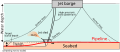 Submarine Pipelines Posttrenching
 -
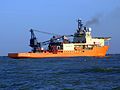 Toisa Polaris
 -
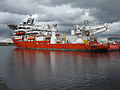 Iremis da Vinci at the Albert Dock Basin, Port of Leith


