Pectineus muscle: Difference between revisions
CSV import Tags: mobile edit mobile web edit |
CSV import |
||
| Line 24: | Line 24: | ||
[[Category:Hip muscles]] | [[Category:Hip muscles]] | ||
{{stub}} | {{stub}} | ||
<gallery> | |||
File:Anterior_Hip_Muscles_2.PNG|Anterior view of hip muscles | |||
File:Gray546.png|Pectineus muscle and surrounding anatomy | |||
File:Gray235.png|Muscles of the iliac and anterior femoral regions | |||
File:Gray344.png|Muscles of the thigh, anterior view | |||
File:Gray430.png|Deep muscles of the thigh | |||
File:Gray433.png|Muscles of the pelvic region | |||
File:Gray549.png|Muscles of the hip and thigh | |||
File:Gray823.png|Muscles of the lower limb | |||
File:Slide3GGGGG.JPG|Pectineus muscle | |||
File:Slide2LLLL.JPG|Pectineus muscle | |||
File:Slide13LLLL.JPG|Pectineus muscle | |||
File:Slide4NNNNN.JPG|Pectineus muscle | |||
</gallery> | |||
Latest revision as of 11:26, 18 February 2025
Pectineus muscle is a flat, quadrangular muscle situated at the anterior (front) part of the upper and medial (inner) aspect of the thigh. The pectineus muscle is the most anterior adductor of the hip. The muscle does adduct and medially rotate the thigh but its primary function is hip flexion.
Etymology[edit]
The term "pectineus" is derived from the Latin word "pecten", which means comb, as the muscle is comb-like in shape.
Structure[edit]
The pectineus muscle originates from the pectineal line of the pubis and to a slight extent from the surface of bone in front of it, between the iliopectineal eminence and pubic tubercle, and from the fascia covering the anterior surface of the muscle. The fibers, directed downward, backward, and lateral, converge to a strong, flat tendon, which is inserted into the pectineal line of the femur, which leads to the lesser trochanter.
Function[edit]
The pectineus muscle is primarily responsible for hip flexion. It also adducts and medially rotates the thigh. As the most anterior adductor of the hip, the pectineus is in a position where it is optimized to flex the hip.
Clinical significance[edit]
Injury to the pectineus muscle or nerve can cause a pectineus muscle strain or groin pain. This can occur in activities that involve kicking, running or changing directions quickly, such as in football, soccer, and martial arts.
See also[edit]
References[edit]
<references />
 | |
|---|---|
 |
 |
-
 Anterior view of hip muscles
 -
 Pectineus muscle and surrounding anatomy
 -
 Muscles of the iliac and anterior femoral regions
 -
 Muscles of the thigh, anterior view
 -
 Deep muscles of the thigh
 -
 Muscles of the pelvic region
 -
 Muscles of the hip and thigh
 -
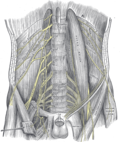 Muscles of the lower limb
 -
 Pectineus muscle
 -
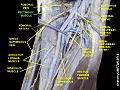 Pectineus muscle
 -
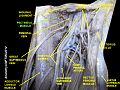 Pectineus muscle
 -
 Pectineus muscle


