Teres major muscle: Difference between revisions
CSV import Tags: mobile edit mobile web edit |
CSV import |
||
| Line 28: | Line 28: | ||
{{stub}} | {{stub}} | ||
<gallery> | |||
File:Teres_major.PNG|Teres major muscle | |||
File:Teres_major_muscle_back.png|Teres major muscle back view | |||
File:Teres_major_muscle_animation.gif|Teres major muscle animation | |||
File:Arm_muscles_back_numbers.png|Arm muscles back view with numbers | |||
File:Gray1211.png|Gray's Anatomy illustration 1211 | |||
File:Gray207.png|Gray's Anatomy illustration 207 | |||
File:Teres_major_muscle.JPG|Teres major muscle | |||
File:Gray203.png|Gray's Anatomy illustration 203 | |||
File:Slide2aaaa.JPG|Teres major muscle | |||
</gallery> | |||
Latest revision as of 11:25, 18 February 2025
Teres Major Muscle
The Teres Major Muscle is a muscle of the upper limb and one of the seven scapulohumeral muscles. It is positioned in the superior part of the posterior compartment of the arm, and is a thick and ovoid muscle in a quadrangular form.
Anatomy[edit]
The Teres Major Muscle originates from the posterior aspect of the scapula and inserts into the humerus. It is innervated by the lower subscapular nerve, a branch of the brachial plexus. The muscle's blood supply comes from the subscapular and circumflex scapular arteries.
Function[edit]
The Teres Major Muscle is a medial rotator and adductor of the humerus and assists in drawing the previously raised humerus downward. It also helps stabilize the humeral head in the glenoid cavity.
Clinical Significance[edit]
Injury to the Teres Major Muscle can result in a condition known as winged scapula, where the scapula protrudes from the back in an abnormal position. This can lead to difficulty in performing movements that require the stable positioning of the scapula, such as pushing, pulling, and lifting.
See Also[edit]
References[edit]
<references />
 | |
|---|---|
 |
 |
-
 Teres major muscle
 -
 Teres major muscle back view
 -
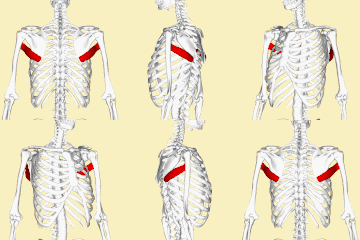 Teres major muscle animation
 -
 Arm muscles back view with numbers
 -
 Gray's Anatomy illustration 1211
 -
 Gray's Anatomy illustration 207
 -
 Teres major muscle
 -
 Gray's Anatomy illustration 203
 -
 Teres major muscle


