Arachnoid mater: Difference between revisions
CSV import |
CSV import |
||
| Line 26: | Line 26: | ||
{{neuroanatomy-stub}} | {{neuroanatomy-stub}} | ||
<gallery> | |||
File:3D_Medical_Illustration_Meninges_Details.jpg|3D Medical Illustration of Meninges Details | |||
File:1316_Meningeal_LayersN.jpg|Meningeal Layers | |||
File:Meninges-en.svg|Diagram of Meninges | |||
File:Gray1196.png|Gray's Anatomy Illustration of Meninges | |||
File:Brain_with_arachnoid_and_pia_mater.jpg|Brain with Arachnoid and Pia Mater | |||
File:Spinal_dura_mater_1.jpg|Spinal Dura Mater | |||
File:Gray767.png|Gray's Anatomy Illustration of Spinal Cord | |||
File:Slide5sese.GIF|Arachnoid mater | |||
File:Slide6Neo.JPG|Arachnoid mater | |||
File:Slide7Neo.JPG|Arachnoid mater | |||
</gallery> | |||
Latest revision as of 11:24, 18 February 2025
Arachnoid mater is one of the three meninges, the protective membranes that cover the brain and spinal cord. It is located between the two other meninges, the pia mater and the dura mater.
Anatomy[edit]
The arachnoid mater is a thin, transparent membrane. It is separated from the dura mater by the subdural space and from the pia mater by the subarachnoid space, which is filled with cerebrospinal fluid. The arachnoid mater does not follow the brain's convolutions like the pia mater does, instead, it bridges over the sulci.
Function[edit]
The primary function of the arachnoid mater, along with the other meninges, is to protect the central nervous system. The arachnoid mater and the pia mater together form the boundaries of the subarachnoid space, which is filled with cerebrospinal fluid. This fluid acts as a cushion to protect the brain and spinal cord from injury.
Clinical significance[edit]
Inflammation of the arachnoid mater is known as arachnoiditis. This can be caused by infection, injury, or complications from surgery. Symptoms can include pain, numbness, and tingling in the limbs. Another condition that can affect the arachnoid mater is an arachnoid cyst, which is a fluid-filled sac that can cause pressure on the brain or spinal cord.
See also[edit]

This article is a neuroanatomy stub. You can help WikiMD by expanding it!
-
 3D Medical Illustration of Meninges Details
 -
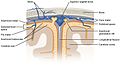 Meningeal Layers
 -
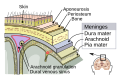 Diagram of Meninges
 -
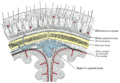 Gray's Anatomy Illustration of Meninges
 -
 Brain with Arachnoid and Pia Mater
 -
 Spinal Dura Mater
 -
 Gray's Anatomy Illustration of Spinal Cord
 -
 Arachnoid mater
 -
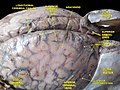 Arachnoid mater
 -
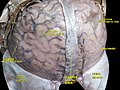 Arachnoid mater


