2017 Central Luzon H5N6 outbreak: Difference between revisions
CSV import |
CSV import |
||
| Line 41: | Line 41: | ||
[[Category:Avian influenza outbreaks]] | [[Category:Avian influenza outbreaks]] | ||
[[Category:Health in the Philippines]] | [[Category:Health in the Philippines]] | ||
<gallery> | |||
File:2017_Avian_Influenza_Outbreak_controlled_radius_map_in_Pampanga,_Philippines.jpg|Map showing controlled radius during the 2017 Central Luzon H5N6 outbreak | |||
File:09446_jfSan_Carlos_Santa_Lucia_Rita_Santo_Tomas_Cruz_San_Luis_Pampanga_Baliuag_Bulacan_Roadsfvf_06.JPG|2017 Central Luzon H5N6 outbreak | |||
File:2017_H5N6_Central_Luzon_outbreak_culling.jpg|Culling operations during the 2017 Central Luzon H5N6 outbreak | |||
</gallery> | |||
Latest revision as of 11:24, 18 February 2025
2017 Central Luzon H5N6 Outbreak[edit]
The 2017 Central Luzon H5N6 outbreak was a significant avian influenza event that occurred in the Central Luzon region of the Philippines. The outbreak involved the highly pathogenic avian influenza (HPAI) virus subtype H5N6, which affected poultry farms in the area, leading to substantial economic and agricultural impacts.
Background[edit]
Avian influenza, commonly known as bird flu, is an infectious viral disease of birds. Most avian influenza viruses do not infect humans; however, some, such as H5N6, can cause severe respiratory illness in humans. The H5N6 subtype is known for its potential to cause severe disease in poultry and has been associated with human infections in other parts of the world.
Outbreak Details[edit]
The outbreak in Central Luzon was first detected in August 2017. It primarily affected the province of Pampanga, a major poultry-producing area in the Philippines. The virus was identified in several poultry farms, prompting immediate response measures from the government and local authorities.
Response Measures[edit]
In response to the outbreak, the Philippine government implemented a series of control measures to prevent the spread of the virus. These included the culling of infected and exposed birds, the establishment of controlled zones, and the restriction of poultry movement within and outside the affected areas. A map was created to delineate the controlled radius in Pampanga, highlighting the areas under quarantine.
Impact[edit]
The outbreak had a significant impact on the local poultry industry, with thousands of birds culled to contain the virus. This led to economic losses for farmers and affected the supply of poultry products in the region. The government provided compensation to affected farmers and worked to restore normalcy in the poultry sector.
Public Health Concerns[edit]
While the H5N6 virus is primarily an avian pathogen, there were concerns about its potential to infect humans. The Department of Health monitored the situation closely, and no human cases were reported during the outbreak. Public health advisories were issued to inform the public about the risks and preventive measures.
Related Pages[edit]
Gallery[edit]
-
 Controlled radius map in Pampanga, Philippines
 -
 Roads in Pampanga, affected by the outbreak
 -
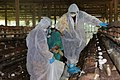 Culling operations during the outbreak


-
Map showing controlled radius during the 2017 Central Luzon H5N6 outbreak
-
2017 Central Luzon H5N6 outbreak
-
Culling operations during the 2017 Central Luzon H5N6 outbreak
