Major urinary proteins: Difference between revisions
CSV import Tags: mobile edit mobile web edit |
CSV import |
||
| Line 27: | Line 27: | ||
[[Category:Chemical communication]] | [[Category:Chemical communication]] | ||
{{biology-stub}} | {{biology-stub}} | ||
== Major_urinary_proteins == | |||
<gallery> | |||
File:Mup1_PDB_1i04.png|Crystal structure of Mup1 | |||
File:Phylogenetic_tree_of_Mups.jpg|Phylogenetic tree of MUPs | |||
File:Mup_locus_showing_DNA_repeats.jpg|Mup locus showing DNA repeats | |||
File:MupwithSBT.jpg|Mup with SBT | |||
File:Protein_gel_showing_mouse_urinary_proteins.jpg|Protein gel showing mouse urinary proteins | |||
File:PrideandPrejudiceCH3detail.jpg|Major urinary proteins | |||
File:Crystal_structure_of_Equ_c_1_dimer.jpg|Crystal structure of Equ c 1 dimer | |||
</gallery> | |||
Latest revision as of 11:18, 18 February 2025
Major Urinary Proteins (MUPs) are a group of proteins that are primarily found in the urine of mice and some other rodents. These proteins play a crucial role in chemical communication among these animals, particularly in conveying information about the individual's identity and territorial boundaries. MUPs are encoded by a large gene family, and the diversity of these proteins allows for a complex system of pheromone signaling.
Function[edit]
The primary function of MUPs is in pheromone signaling. They bind and release volatile pheromones in a controlled manner, thus influencing social and reproductive behaviors among mice. MUPs are also involved in establishing and recognizing territorial boundaries and in individual recognition. This signaling plays a critical role in the complex social structures of mice, affecting mating preferences, aggression, and hierarchy within groups.
Structure[edit]
MUPs are small, lipocalin proteins that have a barrel-shaped structure, which is ideal for binding small hydrophobic molecules such as pheromones. Each MUP gene encodes a slightly different protein, allowing for a variety of pheromones to be bound and released. This diversity is key to the complex signaling and communication that occurs within and between mouse populations.
Genetics[edit]
The genes encoding MUPs are found in a cluster on chromosome 4 in mice. This cluster contains multiple MUP genes, which are highly similar but not identical. This genetic arrangement allows for the production of a variety of MUPs, contributing to the complexity of mouse chemical communication. The expression of these genes is primarily in the liver, from where the proteins are secreted into the blood and eventually excreted in the urine.
Evolution[edit]
The MUP gene family is believed to have undergone significant evolutionary expansion in rodents, particularly in mice, which is thought to be a response to the evolutionary pressures of social communication. The diversity of MUPs allows for a nuanced system of chemical signaling that is critical for the survival and reproductive success of these animals.
Research and Applications[edit]
Research into MUPs has provided insights into the mechanisms of chemical communication and pheromone signaling in animals. Understanding how MUPs function could have implications for controlling pest populations or for research into human pheromones and their potential roles in human behavior and communication.
See Also[edit]

Major_urinary_proteins[edit]
-
 Crystal structure of Mup1
 -
 Phylogenetic tree of MUPs
 -
 Mup locus showing DNA repeats
 -
 Mup with SBT
 -
 Protein gel showing mouse urinary proteins
 -
 Major urinary proteins
 -
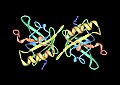 Crystal structure of Equ c 1 dimer


