Adansonia digitata: Difference between revisions
CSV import |
CSV import |
||
| Line 54: | Line 54: | ||
[[Category:Trees of Africa]] | [[Category:Trees of Africa]] | ||
[[Category:Drought-tolerant trees]] | [[Category:Drought-tolerant trees]] | ||
<gallery> | |||
File:Baobab_and_elephant,_Tanzania.jpg|Baobab tree with elephant in Tanzania | |||
File:Baobabcowherd.jpg|Baobab tree with cowherd | |||
File:Baobab_Frucht.jpg|Baobab fruit | |||
File:The_baobab,_Mahajanga.jpg|The baobab in Mahajanga | |||
File:BaobabTree20230926_100418.jpg|Adansonia digitata | |||
File:Starr_080305-3303_Adansonia_digitata.jpg|Adansonia digitata | |||
File:Baobab_-_fruit_pulp_elements_detail_-_Adansonia_digitata.jpg|Baobab fruit pulp elements detail | |||
</gallery> | |||
Latest revision as of 11:17, 18 February 2025
Adansonia digitata[edit]
Adansonia digitata, commonly known as the baobab, is a species of tree native to the African continent. It is one of the nine species of the genus Adansonia, and is the most widespread of the baobabs. The tree is known for its distinctive shape and large trunk, which can store significant amounts of water.
Description[edit]
Adansonia digitata is a large, deciduous tree that can grow up to 25 meters in height and 10 meters in diameter. The trunk is typically cylindrical and can be hollow, providing shelter for various animals and humans. The bark is smooth and grey, and the tree has a lifespan of several thousand years.
The leaves are palmate, with 5 to 7 leaflets, and are shed during the dry season. The flowers are large, white, and pendulous, blooming at night and pollinated by bats and insects.
Distribution and Habitat[edit]
Adansonia digitata is found in the dry, hot savannas of sub-Saharan Africa. It thrives in well-drained soils and is highly drought-resistant, making it well-suited to arid environments.
Ecological Role[edit]
The baobab tree plays a crucial role in its ecosystem. It provides food and shelter for a variety of species, including birds, insects, and mammals. The tree's flowers, fruit, and leaves are all utilized by different organisms.
Uses[edit]
The baobab tree is highly valued for its nutritional and medicinal properties. The fruit, known as "monkey bread," is rich in vitamin C, calcium, and antioxidants. The seeds can be pressed to extract oil, and the leaves are used in traditional medicine.
The bark is used to make rope, baskets, and cloth, while the hollow trunk can serve as a water reservoir or shelter.
Cultural Significance[edit]
The baobab is often referred to as the "Tree of Life" due to its ability to provide food, water, and shelter. It holds cultural significance in many African communities and is often featured in folklore and mythology.
Conservation[edit]
While Adansonia digitata is not currently endangered, it faces threats from habitat loss and climate change. Conservation efforts focus on protecting its natural habitat and promoting sustainable use of its resources.
Gallery[edit]
-
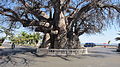 Baobab tree in Mahajanga
 -
 Baobab tree
 -
 Adansonia digitata
 -
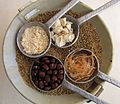 Baobab fruit pulp


Related pages[edit]
-
Baobab tree with elephant in Tanzania
-
Baobab tree with cowherd
-
Baobab fruit
-
The baobab in Mahajanga
-
Adansonia digitata
-
Adansonia digitata
-
Baobab fruit pulp elements detail


