Aldehyde dehydrogenase: Difference between revisions
CSV import |
CSV import |
||
| Line 58: | Line 58: | ||
[[Category:Enzymes]] | [[Category:Enzymes]] | ||
[[Category:Metabolism]] | [[Category:Metabolism]] | ||
<gallery> | |||
File:Monomer_with_an_NAD_(with_surface).png|Monomer with an NAD (with surface) | |||
File:Tetramer_with_NAD_surface.png|Tetramer with NAD surface | |||
File:Active_Site_with_labeled_amino_acids_and_NAD.png|Active Site with labeled amino acids and NAD | |||
File:Mutant_active_site_of_ALDH2*2,_labeled.png|Mutant active site of ALDH2*2, labeled | |||
File:Aldehyde_dehydrogenase_mechanism.png|Aldehyde dehydrogenase mechanism | |||
File:Noradrenaline_breakdown.svg|Noradrenaline breakdown | |||
</gallery> | |||
Latest revision as of 11:17, 18 February 2025
Aldehyde Dehydrogenase[edit]
.png)
Aldehyde dehydrogenase (ALDH) is a group of enzymes that catalyze the oxidation of aldehydes to carboxylic acids. This reaction is crucial in the metabolism of alcohols and the detoxification of aldehydes in the body.
Structure[edit]
Aldehyde dehydrogenases are typically found as tetramers, although they can also exist as monomers. Each subunit of the enzyme contains a binding site for the cofactor NAD+ or NADP+, which is essential for the enzyme's catalytic activity.

Active Site[edit]
The active site of aldehyde dehydrogenase contains several key amino acids that are involved in the catalytic mechanism. These include a cysteine residue that acts as a nucleophile and a glutamate residue that helps in the activation of the aldehyde substrate.

Function[edit]
Aldehyde dehydrogenases play a critical role in the metabolism of alcohols. They convert toxic aldehydes, such as acetaldehyde, into less harmful carboxylic acids, such as acetic acid. This process is important in the breakdown of ethanol in the liver.
Genetic Variants[edit]
There are several genetic variants of aldehyde dehydrogenase, with ALDH2 being one of the most studied. The ALDH2*2 variant is associated with reduced enzyme activity and is common in East Asian populations. This variant can lead to the accumulation of acetaldehyde, causing the "alcohol flush reaction."

Mechanism[edit]
The mechanism of aldehyde dehydrogenase involves the formation of a thiohemiacetal intermediate, followed by hydride transfer to NAD+ and the release of the carboxylic acid product.

Role in Neurotransmitter Metabolism[edit]
Aldehyde dehydrogenases are also involved in the metabolism of neurotransmitters. For example, they participate in the breakdown of noradrenaline by converting its aldehyde form to the corresponding acid.

Related Pages[edit]
Gallery[edit]
-
 Aldehyde dehydrogenase monomer with NAD.
 -
 Tetrameric structure of aldehyde dehydrogenase with NAD.
 -
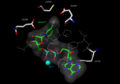 Active site of aldehyde dehydrogenase with labeled amino acids and NAD.
 -
 Mutant active site of ALDH2*2.
 -
 Mechanism of aldehyde dehydrogenase.
 -
 Breakdown of noradrenaline involving aldehyde dehydrogenase.
-
Monomer with an NAD (with surface)
-
Tetramer with NAD surface
-
Active Site with labeled amino acids and NAD
-
Mutant active site of ALDH2*2, labeled
-
Aldehyde dehydrogenase mechanism
-
Noradrenaline breakdown
