Kopi luwak: Difference between revisions
No edit summary |
CSV import |
||
| Line 16: | Line 16: | ||
*[[Animal welfare]] | *[[Animal welfare]] | ||
[[Category:Coffee]] [[Category:Indonesian cuisine]] [[Category:Animal welfare]] | [[Category:Coffee]] [[Category:Indonesian cuisine]] [[Category:Animal welfare]] | ||
<gallery> | |||
File:Roasted_Palawan_Wild_Civet_Coffee1.jpg|Roasted Palawan Wild Civet Coffee | |||
File:Luwak.jpg|Luwak | |||
File:Kopi_Luwak_already_digested_by_Asian_Palm_Civet.jpg|Kopi Luwak already digested by Asian Palm Civet | |||
File:Kopi_Luwak_Gayo,_Takengon,_Aceh.jpg|Kopi Luwak Gayo, Takengon, Aceh | |||
File:Luwak_(civet_cat)_in_cage.jpg|Luwak (civet cat) in cage | |||
File:Luwak_Coffee_Display_In_An_Upscale_Coffee_Shop.jpg|Luwak Coffee Display In An Upscale Coffee Shop | |||
</gallery> | |||
Latest revision as of 11:11, 18 February 2025
Kopi luwak, also known as civet coffee, is a type of coffee that is made from beans that have been eaten and excreted by a civet, a small mammal found in Southeast Asia. The beans are harvested from the civet's feces, cleaned, and roasted to produce a coffee with a unique and distinctive flavor.
History[edit]
Kopi luwak has a long history in Indonesia, where it was originally consumed by the Dutch colonizers during the 18th century. The coffee gained international attention in the early 2000s, when it was featured in the movie "The Bucket List."
Production[edit]
- The process of producing kopi luwak begins with the civet, which eats the coffee cherries and digests the outer layer of the fruit, leaving the coffee beans intact. The beans are then excreted in the animal's feces, and are collected by farmers who clean and roast them to produce the coffee.
- Due to the small production volume and labor-intensive nature of kopi luwak, it is one of the most expensive types of coffee in the world, with prices ranging from $100 to $600 per pound.
Controversy[edit]
- The production of kopi luwak has been criticized by animal welfare organizations, who argue that the practice of keeping civets in captivity and force-feeding them coffee cherries is inhumane.
- To address these concerns, several organizations have developed certification programs for kopi luwak producers, which require them to use only wild civets and to adhere to strict animal welfare standards.
Flavor[edit]
Kopi luwak is known for its unique and distinctive flavor, which is characterized by a smooth and mellow taste, with hints of chocolate and caramel. The coffee is often described as having a lower acidity than other types of coffee, and a slightly earthy aroma.
See also[edit]
-
 Roasted Palawan Wild Civet Coffee
 -
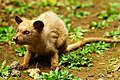 Luwak
Luwak -
 Kopi Luwak already digested by Asian Palm Civet
 -
 Kopi Luwak Gayo, Takengon, Aceh
 -
 Luwak (civet cat) in cage
 -
 Luwak Coffee Display In An Upscale Coffee Shop


_in_cage.jpg)

