Calmodulin: Difference between revisions
CSV import |
CSV import |
||
| Line 25: | Line 25: | ||
File:EFhandmotif.jpg|EF-hand motif | File:EFhandmotif.jpg|EF-hand motif | ||
File:Calmodulin_Binding_sites.gif|Calmodulin binding sites | File:Calmodulin_Binding_sites.gif|Calmodulin binding sites | ||
File:Calmodulin_C-terminal.jpg|Calmodulin C-terminal | |||
File:Calmodulin_N-terminal.jpg|Calmodulin N-terminal | |||
File:Calmodulin_bound_to_MLC_Kinase.jpg|Calmodulin bound to MLC Kinase | |||
File:Sorghum_bicolor_(4171536532).jpg|Calmodulin | |||
</gallery> | |||
<gallery> | |||
File:Calmodulin.png|Calmodulin | |||
File:EFhandmotif.jpg|EF-hand motif | |||
File:Calmodulin_Binding_sites.gif|Calmodulin Binding Sites | |||
File:Calmodulin_C-terminal.jpg|Calmodulin C-terminal | File:Calmodulin_C-terminal.jpg|Calmodulin C-terminal | ||
File:Calmodulin_N-terminal.jpg|Calmodulin N-terminal | File:Calmodulin_N-terminal.jpg|Calmodulin N-terminal | ||
Revision as of 11:11, 18 February 2025
Calmodulin (CaM) is a multifunctional intermediate messenger protein that is expressed in all eukaryotic cells. It is an intracellular target of the secondary messenger Ca^2+ and the binding of Ca^2+ is required for the activation of calmodulin. Once bound to Ca^2+, calmodulin acts as part of a calcium signal transduction pathway by modifying its interactions with various target proteins.
Structure
Calmodulin is a small, highly conserved protein that is 148 amino acids long. The protein has two approximately symmetrical globular domains each of which can bind two calcium ions. The domains are connected by a flexible tether that allows for a large degree of conformational freedom.
Function
Calmodulin mediates processes such as inflammation, metabolism, apoptosis, muscle contraction, intracellular movement, short-term and long-term memory, nerve growth and the immune response. It does this by binding to and regulating a number of different protein targets.
Clinical significance
Mutations in calmodulin genes have been associated with heart arrhythmia, specifically idiopathic ventricular fibrillation and long QT syndrome.
See also
References
<references />
 | |
|---|---|
 |
 |
-
 EF-hand motif
 -
 Calmodulin binding sites
 -
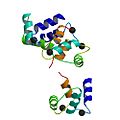 Calmodulin C-terminal
 -
 Calmodulin N-terminal
 -
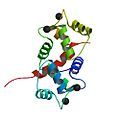 Calmodulin bound to MLC Kinase
 -
 Calmodulin


.jpg)
-
Calmodulin
-
EF-hand motif
-
Calmodulin Binding Sites
-
Calmodulin C-terminal
-
Calmodulin N-terminal
-
Calmodulin bound to MLC Kinase
-
Calmodulin

