Discrete mathematics: Difference between revisions
CSV import |
CSV import |
||
| Line 44: | Line 44: | ||
[[Category:Computer science]] | [[Category:Computer science]] | ||
{{math-stub}} | {{math-stub}} | ||
== Discrete_mathematics == | |||
<gallery> | |||
File:6n-graf.svg|Graph of a 6-node network | |||
File:Sorting_quicksort_anim.gif|Animation of the Quicksort algorithm | |||
File:SimplexRangeSearching.svg|Illustration of simplex range searching | |||
File:WikipediaBinary.svg|Binary tree representation | |||
File:TruncatedTetrahedron.gif|Animation of a truncated tetrahedron | |||
File:Ulam_1.png|Ulam spiral visualization | |||
File:Four_Colour_Map_Example.svg|Example of the four color theorem | |||
</gallery> | |||
Latest revision as of 11:11, 18 February 2025
Discrete Mathematics is a branch of mathematics that deals with objects that can assume only distinct, separated values. The term "discrete mathematics" is therefore used in contrast with "continuous mathematics," which deals with a continuum of objects.
Overview[edit]
Discrete mathematics has become increasingly popular in recent years due to its applicability to computer science. The set of objects studied in discrete mathematics can be finite or infinite. The term finite mathematics is sometimes applied to parts of the field of discrete mathematics that deals with finite sets, particularly those areas relevant to business.
Branches of Discrete Mathematics[edit]
Set Theory[edit]
Set theory is the branch of mathematical logic that studies sets, which are collections of objects. Although any type of object can be collected into a set, set theory is applied most often to objects that are relevant to mathematics.
Graph Theory[edit]
Graph theory is the study of graphs, which are mathematical structures used to model pairwise relations between objects. A graph in this context is made up of vertices, nodes, or points which are connected by edges, arcs, or lines.
Combinatorics[edit]
Combinatorics is an area of mathematics primarily concerned with counting, both as a means and an end in obtaining results, and certain properties of finite structures.
Logic[edit]
Logic is the study of the principles of valid reasoning and inference, as well as of consistence, soundness, and completeness.
Applications[edit]
Discrete mathematics is the mathematical language of computer science, and as such, its importance has increased dramatically in recent decades. Applications of discrete mathematics include:
- Computer algorithms
- Data structures
- Cryptography
- Database design
- Software engineering
- Computer networks
See Also[edit]

This article is a mathematics-related stub. You can help WikiMD by expanding it!
Discrete_mathematics[edit]
-
 Graph of a 6-node network
 -
 Animation of the Quicksort algorithm
 -
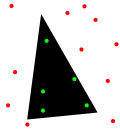 Illustration of simplex range searching
 -
 Binary tree representation
 -
 Animation of a truncated tetrahedron
 -
 Ulam spiral visualization
 -
 Example of the four color theorem


