Cochlear nucleus: Difference between revisions
CSV import |
CSV import |
||
| Line 32: | Line 32: | ||
{{medicine-stub}} | {{medicine-stub}} | ||
<gallery> | |||
File:Gray691.png|Cochlear nucleus | |||
File:Gray760.png|Cochlear nucleus | |||
File:Gray683.png|Cochlear nucleus | |||
File:Gray696.png|Cochlear nucleus | |||
File:Gray698.png|Cochlear nucleus | |||
File:Gray713.png|Cochlear nucleus | |||
File:Lower_pons_horizontal_KB.svg|Cochlear nucleus | |||
</gallery> | |||
Latest revision as of 11:10, 18 February 2025
Cochlear nucleus
The cochlear nucleus is a complex of nuclei in the brainstem that plays a fundamental role in the auditory system. It is the first central auditory station in the pathway from the inner ear to the auditory cortex. The cochlear nucleus receives input from the cochlea via the auditory nerve and processes auditory information before sending it to higher brain centers.
Structure[edit]
The cochlear nucleus is divided anatomically into three main parts: the dorsal cochlear nucleus (DCN), the ventral cochlear nucleus (VCN), and the posteroventral cochlear nucleus (PVCN). Each of these parts has distinct cell types and plays different roles in processing sound.
Dorsal Cochlear Nucleus[edit]
The DCN is located at the dorsomedial part of the cochlear nucleus and contains several types of neurons, including pyramidal cells, giant cells, and granule cells. It is involved in processing the spectral qualities of sound, which helps in distinguishing different sounds.
Ventral Cochlear Nucleus[edit]
The VCN is further divided into the anteroventral cochlear nucleus (AVCN) and the posteroventral cochlear nucleus (PVCN). These regions contain various neurons, such as bushy cells, octopus cells, and stellate cells, which are crucial for timing and intensity cues of sounds.
Posteroventral Cochlear Nucleus[edit]
The PVCN, often considered part of the VCN, plays a role in sound localization and intensity discrimination.
Function[edit]
The cochlear nucleus processes auditory information in several ways. It helps in sound localization, frequency resolution, and temporal processing. The DCN, for instance, is involved in the analysis of the spectral content of sounds, which is essential for recognizing complex sounds like speech and music. The VCN, on the other hand, processes temporal and intensity cues that are critical for sound localization and speech understanding in noisy environments.
Pathways[edit]
From the cochlear nucleus, auditory information is transmitted to higher centers in the brain through several pathways. The primary pathways include projections to the superior olivary complex, the nucleus of the lateral lemniscus, and directly to the inferior colliculus. These pathways are involved in further processing of auditory information, including sound localization and the startle reflex.
Clinical Significance[edit]
Damage to the cochlear nucleus or its pathways can lead to hearing loss or auditory processing disorders. Conditions such as auditory neuropathy spectrum disorder (ANSD) can affect the transmission of sound information from the cochlea to the cochlear nucleus and beyond, leading to difficulties in understanding speech, especially in noisy environments.
Research[edit]
Research on the cochlear nucleus is ongoing, with studies focusing on understanding its role in auditory processing, the effects of hearing loss on its function, and potential treatments for auditory disorders. Cochlear implants, for example, directly stimulate the auditory nerve, bypassing damaged parts of the ear but still relying on the cochlear nucleus for processing sound.

-
 Cochlear nucleus
 -
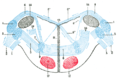 Cochlear nucleus
 -
 Cochlear nucleus
 -
 Cochlear nucleus
 -
 Cochlear nucleus
 -
 Cochlear nucleus
 -
 Cochlear nucleus


