Tantalum: Difference between revisions
CSV import Tags: mobile edit mobile web edit |
CSV import |
||
| Line 31: | Line 31: | ||
{{stub}} | {{stub}} | ||
{{dictionary-stub1}} | {{dictionary-stub1}} | ||
<gallery> | |||
File:DOSBIWoneRotamer.png|Tantalum | |||
File:Tantalite.jpg|Tantalite mineral | |||
File:World_Tantalum_Production_2015.svg|World Tantalum Production 2015 | |||
File:World_Tantalum_Production_2006.svg|World Tantalum Production 2006 | |||
File:Tantalum_world_production.svg|Tantalum world production | |||
File:Tantal-Perle-Wiki-07-02-25-P1040364b.jpg|Tantalum pearl | |||
File:Tantalio.png|Tantalum | |||
</gallery> | |||
Latest revision as of 11:09, 18 February 2025
Tantalum is a chemical element with the symbol Ta and atomic number 73. It is a rare, hard, blue-gray, lustrous transition metal that is highly corrosion-resistant. It is part of the refractory metals group, which are widely used as minor components in alloys. The chemical inertness of tantalum makes it a valuable substance for laboratory equipment and a substitute for platinum. Its main use today is in tantalum capacitors in electronic equipment such as mobile phones, DVD players, video game systems and computers. Tantalum, always together with the chemically similar niobium, occurs in the mineral groups tantalite, columbite and coltan (a mix of columbite and tantalite, though not recognised as a separate mineral species).
Characteristics[edit]
Tantalum is dark (blue-gray), dense, ductile, very hard, easily fabricated, and highly conductive of heat and electricity. The metal is renowned for its resistance to corrosion by acids; in fact, at temperatures below 150 °C tantalum is almost completely immune to attack by the normally aggressive aqua regia. It can be dissolved with hydrofluoric acid or acidic solutions containing the fluoride ion and sulfur trioxide, as well as with a solution of potassium hydroxide. Tantalum's high melting point of 3017 °C (boiling point 5458 °C) is exceeded only by tungsten, rhenium and osmium for elements that have melting points.
Applications[edit]
Tantalum is used in the electronics industry for capacitors and high power resistors. It is also used to make alloys to increase strength, ductility and corrosion resistance. The metal is used in dental and surgical instruments and implants, as it causes no immune response.
History[edit]
Tantalum was discovered in Sweden in 1802 by Anders Ekeberg, in two mineral samples – one from Sweden and the other from Finland. One year earlier, Charles Hatchett had discovered columbium (now niobium), and in 1809 the English chemist William Hyde Wollaston compared its oxide, columbite with a density of 5.918 g/cm3, to that of tantalum, tantalite with a density of 7.935 g/cm3. He concluded that the two oxides, despite their difference in measured density, were identical and kept the name tantalum.
See also[edit]
References[edit]
<references />
External links[edit]
 | This medical article is a stub. You can help WikiMD by expanding the page. |
-
 Tantalum
 -
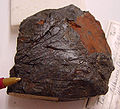 Tantalite mineral
 -
 World Tantalum Production 2015
 -
 World Tantalum Production 2006
 -
 Tantalum world production
 -
 Tantalum pearl
 -
 Tantalum


