Hormosira: Difference between revisions
CSV import Tags: mobile edit mobile web edit |
CSV import |
||
| Line 27: | Line 27: | ||
{{Algae-stub}} | {{Algae-stub}} | ||
<gallery> | |||
File:KaikNZhorm.jpg|Hormosira banksii at Kaikoura, New Zealand | |||
File:Hormosira_banksii_Long_Reef.jpg|Hormosira banksii at Long Reef | |||
File:Tessellated_Pavement_19.jpg|Hormosira banksii at Tessellated Pavement | |||
File:Petrified_log_at_Curio_Bay.jpg|Hormosira banksii at Curio Bay | |||
File:Femalehorm.jpg|Female Hormosira banksii | |||
File:Malehorm.jpg|Male Hormosira banksii | |||
File:Nothhormo.jpg|Hormosira banksii | |||
</gallery> | |||
Latest revision as of 11:09, 18 February 2025
Hormosira is a genus of brown algae, commonly known as Neptune's necklace, sea grapes, or bubbleweed. It is found in temperate waters, particularly in the Southern Hemisphere, including the coasts of Australia, New Zealand, and South Africa. Hormosira banksii is the most well-known species within this genus, easily recognizable by its string of bead-like segments.
Description[edit]
Hormosira species are characterized by their distinctive morphology, consisting of chains of bladder-like structures or segments, which are filled with air and help the algae to float. These segments are spherical to oval in shape, and the chains can grow quite long, sometimes reaching several meters in length. The color of Hormosira can vary from a deep brown to a greenish hue, depending on environmental conditions such as light exposure and water quality.
Habitat and Distribution[edit]
Hormosira primarily inhabits intertidal zones, where it attaches to rocky substrates. It is a key species in its ecosystem, providing habitat and food for a variety of marine organisms. The distribution of Hormosira is largely confined to temperate regions of the Southern Hemisphere. Its presence is a common sight in rock pools and along the rocky shorelines where it forms dense mats, contributing significantly to the biodiversity of these areas.
Reproduction[edit]
Reproduction in Hormosira is both sexual and asexual, with the former being the predominant mode. The algae undergoes a complex life cycle typical of many brown algae, involving an alternation of generations. The thallus that is commonly observed is the diploid sporophyte, which produces zoospores in specialized structures called conceptacles. These zoospores develop into haploid gametophytes, which then produce gametes. Fertilization of gametes results in the formation of a new diploid sporophyte, completing the cycle.
Ecological Importance[edit]
Hormosira plays a crucial role in its ecosystem, acting as a primary producer and providing both food and shelter for a variety of marine species. Its dense mats offer protection to small invertebrates and serve as nursery grounds for several species of fish. Additionally, Hormosira can help stabilize the substrate, reducing erosion and promoting the accumulation of sediments.
Conservation[edit]
While not currently listed as endangered, the health of Hormosira populations can be affected by environmental stressors such as pollution, climate change, and habitat destruction. Efforts to monitor and protect its habitats are essential for the conservation of this species and the overall health of intertidal ecosystems.
See Also[edit]

-
 Hormosira banksii at Kaikoura, New Zealand
 -
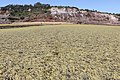 Hormosira banksii at Long Reef
 -
 Hormosira banksii at Tessellated Pavement
 -
 Hormosira banksii at Curio Bay
 -
 Female Hormosira banksii
 -
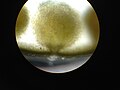 Male Hormosira banksii
 -
 Hormosira banksii


