Solanidine: Difference between revisions
CSV import |
CSV import |
||
| Line 24: | Line 24: | ||
{{Chemistry-stub}} | {{Chemistry-stub}} | ||
{{Toxicology-stub}} | {{Toxicology-stub}} | ||
<gallery> | |||
File:Solanidine.svg|Solanidine | |||
File:Electrochemical_oxidation_of_Solanidine.svg|Electrochemical oxidation of Solanidine | |||
File:Solanidine_to_16-DPA_conversion.svg|Solanidine to 16-DPA conversion | |||
File:Solanidine_von_Braun.svg|Solanidine von Braun | |||
File:Schramm_reaction.svg|Schramm reaction | |||
File:Schreiber_reaction.svg|Schreiber reaction | |||
</gallery> | |||
Latest revision as of 11:08, 18 February 2025
Solanidine is a steroidal alkaloid base that is found in plants of the Solanaceae family, which includes species such as potatoes, tomatoes, and eggplants. It is a precursor to a variety of other steroidal alkaloids, including solanine and chaconine, which are toxic to humans and animals.
Chemical Structure and Properties[edit]
Solanidine is a tetracyclic compound with a structure similar to cholesterol. It has a molecular formula of C27H43NO and a molecular weight of 399.64 g/mol. The compound is a white crystalline solid at room temperature and is soluble in organic solvents such as ethanol and chloroform.
Biosynthesis[edit]
The biosynthesis of solanidine involves several steps. It begins with the conversion of cholesterol to pregnenolone, which is then converted to progesterone. Progesterone is converted to solanidine through a series of enzymatic reactions involving hydroxylation, oxidation, and rearrangement of the steroid ring structure.
Toxicity[edit]
Solanidine and its derivatives, solanine and chaconine, are toxic to humans and animals. They can cause symptoms such as nausea, vomiting, abdominal pain, and in severe cases, neurological disorders. The toxicity is due to the ability of these compounds to interfere with the function of cell membranes, leading to cell death.
Detection and Quantification[edit]
Methods for the detection and quantification of solanidine and its derivatives in plant tissues and food products include high-performance liquid chromatography (HPLC), gas chromatography-mass spectrometry (GC-MS), and liquid chromatography-mass spectrometry (LC-MS).
See Also[edit]


This article is a toxicology-related stub. You can help WikiMD by expanding it!
-
 Solanidine
 -
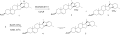 Electrochemical oxidation of Solanidine
 -
 Solanidine to 16-DPA conversion
 -
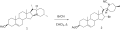 Solanidine von Braun
 -
 Schramm reaction
 -
 Schreiber reaction


