Skipjack (boat): Difference between revisions
CSV import Tags: mobile edit mobile web edit |
CSV import Tags: mobile edit mobile web edit |
||
| Line 28: | Line 28: | ||
[[Category:Maritime history of the United States]] | [[Category:Maritime history of the United States]] | ||
{{food-stub}} | {{food-stub}} | ||
<gallery> | |||
File:Ada_Fears_Inbound.jpg|Ada Fears Inbound | |||
File:Skipjack_EPA.PNG|Skipjack EPA | |||
File:Skipjack_seen_from_the_front.jpg|Skipjack seen from the front | |||
File:Skipjack_H.M._Krentz_and_pushboat.jpg|Skipjack H.M. Krentz and pushboat | |||
File:Batch_2_6(1)_skipjack_sunfish_sail_1(1)_adjust.png|Skipjack (boat) | |||
File:Chesapeake_Bay_skipjacks_drying_sails_while_inport.jpg|Chesapeake Bay skipjacks drying sails while in port | |||
</gallery> | |||
Latest revision as of 11:06, 18 February 2025
Skipjack (boat)
The Skipjack is a type of traditional fishing boat that is most commonly associated with the Chesapeake Bay area in the United States. It is recognized for its distinctive design and its role in the oyster dredging industry.
History[edit]
The Skipjack emerged in the late 19th century, during a period of rapid industrialization in the United States. The design of the boat was specifically tailored to the conditions of the Chesapeake Bay and the needs of the local oyster dredging industry. The Skipjack's shallow draft, wide beam, and large sail area made it an ideal vessel for navigating the shallow waters of the bay and for dredging oysters from the sea floor.
Design[edit]
The Skipjack is a single-masted, two-sailed vessel. The main sail is a large, four-cornered sail that is hoisted from a boom and gaff. The jib, or foresail, is a smaller, triangular sail that is set forward of the mast. The hull of the Skipjack is flat-bottomed and broad, with a sharp bow and a square stern. The boat is typically constructed of wood, although some modern versions may use other materials.
Role in the Oyster Dredging Industry[edit]
The Skipjack played a crucial role in the oyster dredging industry in the Chesapeake Bay. The boat's design allowed it to navigate the shallow waters of the bay and to dredge oysters efficiently. The large sail area provided the power needed to pull the heavy dredges across the sea floor, while the wide beam and flat bottom provided stability during the dredging operation.
Preservation and Legacy[edit]
Today, the Skipjack is recognized as a symbol of the Chesapeake Bay's maritime heritage. Efforts have been made to preserve the remaining Skipjacks and to promote the understanding and appreciation of these historic vessels. Several Skipjacks have been listed on the National Register of Historic Places.
See Also[edit]

-
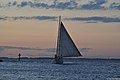 Ada Fears Inbound
 -
 Skipjack EPA
 -
 Skipjack seen from the front
 -
 Skipjack H.M. Krentz and pushboat
 -
 Skipjack (boat)
 -
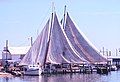 Chesapeake Bay skipjacks drying sails while in port


_skipjack_sunfish_sail_1(1)_adjust.png)

