Urban metabolism: Difference between revisions
CSV import |
CSV import |
||
| Line 49: | Line 49: | ||
[[Category:Urban studies and planning]] | [[Category:Urban studies and planning]] | ||
[[Category:Sustainability]] | [[Category:Sustainability]] | ||
== Urban_metabolism == | |||
<gallery> | |||
File:Greenhouse_Effect_(2017_NASA_data).svg|Greenhouse Effect (2017 NASA data) | |||
File:Energy_Systems_Symbols_H.gif|Energy Systems Symbols | |||
File:MFASystem_1.png|Urban metabolism | |||
File:Sustainable_development.svg|Sustainable development | |||
</gallery> | |||
Latest revision as of 11:06, 18 February 2025
Urban Metabolism[edit]
.svg)
Urban metabolism is a model used to facilitate the understanding of the flows of materials and energy within cities. It draws an analogy between the city and a living organism, where resources are consumed and waste is expelled. This concept is crucial for analyzing the sustainability of urban areas and for planning more efficient and environmentally friendly cities.
History[edit]
The concept of urban metabolism was first introduced in the 1960s by Abel Wolman, who used it to describe the resource consumption and waste generation of a hypothetical American city. Since then, the model has evolved to incorporate various dimensions of urban life, including social, economic, and environmental factors.
Components[edit]
Energy[edit]

Energy is a critical component of urban metabolism. Cities require vast amounts of energy for transportation, heating, cooling, and powering industries. The efficiency of energy use and the sources from which energy is derived significantly impact the sustainability of urban areas.
Water[edit]
Water is another essential element of urban metabolism. Cities need water for residential, industrial, and recreational purposes. The management of water resources, including supply, distribution, and wastewater treatment, is vital for maintaining urban health and sustainability.
Materials[edit]
Cities consume a wide range of materials, from construction materials to consumer goods. The flow of materials through a city, including their production, consumption, and disposal, is a key focus of urban metabolism studies.
Waste[edit]
Waste management is a significant challenge in urban areas. Effective waste management systems are necessary to minimize environmental impact and promote recycling and reuse of materials.
Applications[edit]
Urban metabolism is used in urban planning and policy-making to design cities that are more sustainable and resilient. By understanding the flows of energy, water, and materials, planners can identify inefficiencies and develop strategies to reduce resource consumption and waste production.
Challenges[edit]
One of the main challenges in applying urban metabolism is the complexity of urban systems. Cities are dynamic and involve numerous interacting components, making it difficult to model and analyze their metabolism accurately.
Related Concepts[edit]
Sustainable Development[edit]

Urban metabolism is closely related to the concept of sustainable development, which aims to meet the needs of the present without compromising the ability of future generations to meet their own needs.
Greenhouse Effect[edit]
The greenhouse effect is a critical consideration in urban metabolism, as cities are significant sources of greenhouse gas emissions. Understanding and mitigating these emissions is essential for sustainable urban development.
Related Pages[edit]
References[edit]
- Kennedy, C., Cuddihy, J., & Engel-Yan, J. (2007). The changing metabolism of cities. Journal of Industrial Ecology, 11(2), 43-59.
- Wolman, A. (1965). The metabolism of cities. Scientific American, 213(3), 179-190.
Urban_metabolism[edit]
-
 Greenhouse Effect (2017 NASA data)
 -
 Energy Systems Symbols
 -
 Urban metabolism
 -
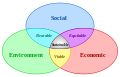 Sustainable development

