Windowpane oyster: Difference between revisions
CSV import |
CSV import |
||
| Line 35: | Line 35: | ||
{{Bivalve-stub}} | {{Bivalve-stub}} | ||
{{food-stub}} | {{food-stub}} | ||
<gallery> | |||
File:Capizshell.jpg|Capiz shell | |||
File:672Parish_San_Jose_Bamboo_Organ_Las_Piñas_Church_39.jpg|Bamboo Organ at Las Piñas Church | |||
File:Simple_capiz_parol.jpg|Simple capiz parol | |||
File:MuseoSanPablojf7215_06.JPG|Museo San Pablo | |||
File:Calasiao_Church_convent_--_window.JPG|Calasiao Church convent window | |||
File:Trinoma_capiz_shells_stoops_Mary_Mother_of_Hope_Chapel_The_Landmark2.jpg|Trinoma capiz shells stoops | |||
</gallery> | |||
Latest revision as of 11:05, 18 February 2025
Windowpane Oyster
The Windowpane Oyster (Placuna placenta) is a bivalve marine mollusk belonging to the family Placunidae. It is also commonly known as Capiz Shell in the Philippines and as Kapis in Malaysia.
Description[edit]
The Windowpane Oyster is named for its thin, flat, translucent shells, which are reminiscent of a windowpane. The shells can reach up to 30 cm in diameter. The oyster itself is small and not typically used for food, but the shells have been used for various purposes throughout history.
Habitat and Distribution[edit]
Windowpane Oysters are found in the warm seas of the Indian Ocean and the western Pacific Ocean. They are particularly abundant in the coastal waters of the Philippines, Indonesia, and Malaysia.
Uses[edit]
The primary use of the Windowpane Oyster is the shell, which is a significant source of livelihood for many coastal communities. The shells are used in the manufacture of various products such as jewelry, window panes, chandeliers, and decorative items. The shells are also used in the construction industry as a substitute for glass.
Conservation Status[edit]
The Windowpane Oyster is not currently listed as threatened or endangered. However, overharvesting and habitat destruction pose significant threats to its population. Conservation efforts are focused on sustainable harvesting practices and habitat protection.
See Also[edit]
References[edit]
<references />


-
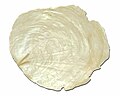 Capiz shell
 -
 Bamboo Organ at Las Piñas Church
 -
 Simple capiz parol
 -
 Museo San Pablo
 -
 Calasiao Church convent window
 -
 Trinoma capiz shells stoops


