Submarine escape training facility: Difference between revisions
CSV import Tags: mobile edit mobile web edit |
CSV import |
||
| Line 29: | Line 29: | ||
{{military-stub}} | {{military-stub}} | ||
{{safety-stub}} | {{safety-stub}} | ||
== Submarine_escape_training_facility == | |||
<gallery> | |||
File:Submarine_Escape_Training_Tower_from_the_outside.jpg|Submarine Escape Training Tower from the outside | |||
File:SETT_Divers.jpg|Divers at the Submarine Escape Training Tower | |||
File:SETT_pooltop.jpg|Top view of the pool at the Submarine Escape Training Tower | |||
File:Pearl_Harbor_Submarine_Escape_Trainer.JPG|Pearl Harbor Submarine Escape Trainer | |||
File:Submarine_Escape_Training_Triton12.jpg|Submarine Escape Training Triton 12 | |||
File:Triton_12_at_swimmingpool_Het_Heersdiep.jpg|Triton 12 at swimming pool Het Heersdiep | |||
</gallery> | |||
Latest revision as of 11:05, 18 February 2025
Submarine Escape Training Facility (SETF) is a specialized training facility designed to instruct and prepare submarine crew members in the procedures and techniques necessary for escaping from a disabled submarine. These facilities are critical for ensuring the safety and survival of submariners in emergency situations.
History[edit]
The concept of a Submarine Escape Training Facility originated in the early 20th century, following the advent of military submarines and the inherent risks associated with their operation. The first SETF was established by the Royal Navy in the United Kingdom in 1930. Since then, several other nations with submarine fleets, including the United States, Russia, and China, have developed their own facilities.
Design and Features[edit]
A typical Submarine Escape Training Facility features a variety of components designed to simulate the conditions of a disabled submarine. The most prominent feature is often a large diving tank or tower filled with water, which can be used to simulate the pressure conditions of a submerged submarine. Trainees learn to use escape equipment and procedures in this controlled environment before applying them in real-world scenarios.
Training Procedures[edit]
Training at a SETF typically involves both classroom instruction and practical exercises. Theoretical instruction covers topics such as the physics of deep-sea pressure, the use of breathing apparatus, and the physiological effects of rapid ascent. Practical exercises may include escaping from a mock submarine hatch, ascending through a water-filled tower, and using life rafts and survival equipment.
Importance[edit]
The training provided at a Submarine Escape Training Facility is crucial for the safety of submariners. It equips them with the knowledge and skills necessary to survive in the event of a submarine disaster. Furthermore, it instills confidence in the crew, knowing they have been trained to handle such emergencies.
See Also[edit]


This safety related article is a stub. You can help WikiMD by expanding it.
Submarine_escape_training_facility[edit]
-
 Submarine Escape Training Tower from the outside
 -
 Divers at the Submarine Escape Training Tower
 -
 Top view of the pool at the Submarine Escape Training Tower
 -
Pearl Harbor Submarine Escape Trainer
-
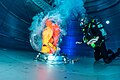 Submarine Escape Training Triton 12
 -
 Triton 12 at swimming pool Het Heersdiep


