High-performance liquid chromatography: Difference between revisions
CSV import |
CSV import |
||
| Line 22: | Line 22: | ||
[[Category:Laboratory techniques]] | [[Category:Laboratory techniques]] | ||
{{Chemistry-stub}} | {{Chemistry-stub}} | ||
== High-performance liquid chromatography == | |||
<gallery> | |||
File:HPLC_Instrument.jpg|HPLC Instrument | |||
File:HPLC_apparatus.svg|HPLC Apparatus | |||
File:HILIC_Partition_Method_Graphic.png|HILIC Partition Method Graphic | |||
File:Hplc-perfume-chromatogram.png|HPLC Perfume Chromatogram | |||
File:HPLC_extraction_and_use.jpg|HPLC Extraction and Use | |||
File:Reverse_Phase_Gradient_Elution_Schematic.svg|Reverse Phase Gradient Elution Schematic | |||
File:SST_Equations_single_peak.jpg|SST Equations Single Peak | |||
File:Nano-LC_-_(1).jpg|Nano-LC | |||
</gallery> | |||
Latest revision as of 11:03, 18 February 2025
High-performance liquid chromatography (HPLC) is a type of chromatography used in analytical chemistry to separate, identify, and quantify each component in a mixture. It relies on pumps to pass a pressurized liquid solvent containing the sample mixture through a column filled with a solid adsorbent material. Each component in the sample interacts slightly differently with the adsorbent material, causing different flow rates for the different components and leading to the separation of the components as they flow out of the column.
History[edit]
HPLC was first developed in the late 1960s by Csaba Horváth who also established the principles of HPLC in the same decade. The technique was first used for large bio-molecules because it was not applicable to many of the smaller molecules. However, it has since been improved and expanded to cover a wide range of molecular weights.
Principle[edit]
The basic principle of HPLC is based on the partition coefficient principle. The sample is introduced into the mobile phase stream and is transported through the column. The analyte (substance to be separated) partitions between the mobile and stationary phases. The stationary phase is a porous solid which can be a packed column or a capillary tube. The mobile phase is a liquid which can be an organic or aqueous solution.
Types of HPLC[edit]
There are several types of HPLC which are classified based on the type of stationary phase, the composition of the mobile phase, and the detection method. These include Reverse phase HPLC (RP-HPLC), Normal phase HPLC (NP-HPLC), Size exclusion HPLC (SE-HPLC), and Ion exchange HPLC (IEC-HPLC).
Applications[edit]
HPLC has a wide range of applications in fields such as pharmaceutical industry, biochemistry, and environmental science. It is used for the analysis and purification of various types of molecules, screening drug compounds, and maintaining the quality of product. HPLC is also used in the production of pharmaceuticals and biological products.
See also[edit]

High-performance liquid chromatography[edit]
-
 HPLC Instrument
 -
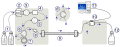 HPLC Apparatus
 -
 HILIC Partition Method Graphic
 -
 HPLC Perfume Chromatogram
 -
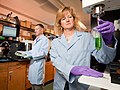 HPLC Extraction and Use
 -
 Reverse Phase Gradient Elution Schematic
 -
 SST Equations Single Peak
 -
 Nano-LC


.jpg)
