Women's March on Versailles: Difference between revisions
CSV import |
CSV import |
||
| Line 23: | Line 23: | ||
[[Category:Protests in France]] | [[Category:Protests in France]] | ||
{{History-stub}} | {{History-stub}} | ||
<gallery> | |||
File:A_Versailles,_à_Versailles_5_octobre_1789_-_Restoration.jpg|Women's March on Versailles | |||
File:Declaration_of_Human_Rights.jpg|Declaration of Human Rights | |||
File:MarchWomenVersailles5-6october1789.jpg|Women's March on Versailles | |||
File:Map_of_Versailles_in_1789_by_William_R_Shepherd_(died_1934).jpg|Map of Versailles in 1789 | |||
File:Bed_Lodewijk_XIV.jpg|Women's March on Versailles | |||
File:Marquis_de_Lafayette_1.jpg|Marquis de Lafayette | |||
File:La_Fayette_and_Marie_Antoinette_6th_october_1789.jpg|La Fayette and Marie Antoinette, 6th October 1789 | |||
File:1822_Tuileries_Paris.png|Women's March on Versailles | |||
File:AduC_091_,_1889_engraving_of_Louis_Philippe_d'Orléans,_Duke_of_Orléans_(known_as_Philippe_Égalité).jpg|Louis Philippe d'Orléans, Duke of Orléans | |||
</gallery> | |||
Latest revision as of 11:02, 18 February 2025

Women's March on Versailles
The Women's March on Versailles, also known as The October March, The October Days, or simply The March on Versailles, was one of the earliest and most significant events of the French Revolution. The march began among women in the marketplaces of Paris who were near rioting over the high price and scarcity of bread. Their demands eventually encompassed a broader spectrum of political action, including reforms and the demand for the French royal family to return to Paris from their residence in Versailles.
Background[edit]
The economic and political atmosphere in France leading up to the march was volatile. The country was grappling with a severe financial crisis, exacerbated by involvement in various wars, including the American Revolutionary War, and the extravagant spending of the royal family. The Estates-General of 1789 had been convened to address these issues, but the assembly's transformation into the National Constituent Assembly and the subsequent Tennis Court Oath signaled a significant shift in power from the monarchy to the people, laying the groundwork for revolutionary change.
The March[edit]
The march began on October 5, 1789. Initially, it was driven by women's frustration over the bread shortage and high prices. These women, numbering in the thousands, were soon joined by revolutionaries and National Guardsmen. The crowd demanded not only bread but also political reforms, the acceptance of the August Decrees, and the endorsement of the Declaration of the Rights of Man and of the Citizen by King Louis XVI.
Upon reaching Versailles, the crowd invaded the Palace of Versailles, killing several guards. The confrontation forced the king to address the crowd and agree to their demands, including the immediate provision of bread. Most significantly, the king, his family, and the French Assembly were compelled to return with the crowd to Paris, symbolizing a significant transfer of political power from the monarchy to the people.
Aftermath[edit]
The Women's March on Versailles proved to be a pivotal moment in the French Revolution. It marked the end of royal authority's inviolability and showcased the power of popular movements. The return of the king and the assembly to Paris signaled a new phase in the revolution, where the monarchy would increasingly find itself at odds with the revolutionary government and the people.
The march also highlighted the significant role women played in the revolution, not only as participants in political action but as initiators of such action. This event set the stage for further involvement of women in the revolution, although their rights and demands would often be sidelined by the male-dominated leadership.
Legacy[edit]
The Women's March on Versailles remains a symbol of the power of popular movements and the significant role women can play in political change. It is commemorated as a key event in the history of the French Revolution, illustrating the potential for direct action to effect significant political and social change.

-
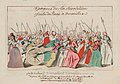 Women's March on Versailles
 -
 Declaration of Human Rights
 -
 Women's March on Versailles
 -
 Map of Versailles in 1789
 -
 Women's March on Versailles
 -
 Marquis de Lafayette
 -
 La Fayette and Marie Antoinette, 6th October 1789
 -
 Women's March on Versailles
 -
 Louis Philippe d'Orléans, Duke of Orléans


.jpg)


.jpg)
