Succinate dehydrogenase: Difference between revisions
CSV import Tags: mobile edit mobile web edit |
CSV import |
||
| Line 21: | Line 21: | ||
[[Category:Mitochondrial biology]] | [[Category:Mitochondrial biology]] | ||
{{medicine-stub}} | {{medicine-stub}} | ||
== Succinate dehydrogenase == | |||
<gallery> | |||
File:Succinate_Dehydrogenase_1YQ3_and_Membrane.png|Succinate dehydrogenase structure and membrane association | |||
File:SuccDeh.svg|Diagram of succinate dehydrogenase | |||
File:S.D.Oxidation_of_Succinate_E2.gif|Oxidation of succinate via E2 mechanism | |||
File:S.D.Oxidation_of_Succinate_E1cb.gif|Oxidation of succinate via E1cb mechanism | |||
File:QuinoneMechanism.gif|Quinone mechanism in succinate dehydrogenase | |||
File:Succinate_Dehydrogenase_1YQ3_Electron_Carriers_Labeled.png|Electron carriers in succinate dehydrogenase labeled | |||
</gallery> | |||
Latest revision as of 11:01, 18 February 2025

Succinate dehydrogenase (SDH) is an enzyme that plays a critical role in the mitochondrial electron transport chain, where it participates in the complex process of cellular respiration. It is also known as succinate-coenzyme Q reductase or complex II. This enzyme is unique as it participates in both the citric acid cycle (also known as the Krebs cycle) and the electron transport chain, serving as a critical link between the two major pathways of cellular energy production.
Function[edit]
SDH catalyzes the oxidation of succinate to fumarate, with the simultaneous reduction of ubiquinone (coenzyme Q) to ubiquinol. This reaction is vital for the production of ATP (adenosine triphosphate), the energy currency of the cell. By contributing to the proton gradient used by ATP synthase, SDH plays a crucial role in the generation of ATP through oxidative phosphorylation.
Structure[edit]
The enzyme is composed of four subunits: two hydrophilic ones (SDHA and SDHB) that contain the active site and two hydrophobic membrane-anchoring subunits (SDHC and SDHD) that anchor the enzyme to the inner mitochondrial membrane. The SDHA subunit contains a flavin adenine dinucleotide (FAD) cofactor, which is involved in the initial oxidation of succinate. The SDHB subunit contains iron-sulfur clusters that facilitate the transfer of electrons to ubiquinone.
Genetic and Clinical Significance[edit]
Mutations in the genes encoding the SDH subunits can lead to a variety of diseases, collectively known as mitochondrial diseases. These include hereditary paraganglioma and pheochromocytoma, which are tumors of the nervous system, and Leigh syndrome, a severe neurological disorder that typically arises in infancy. The study of SDH mutations has also provided insights into the mechanisms of cancer development, as SDH acts as a tumor suppressor.
Inhibitors[edit]
Certain chemicals can inhibit the activity of SDH, affecting cellular respiration and energy production. These include malonate, an analog of succinate that competes with succinate for the active site of SDH, and thenoyltrifluoroacetone (TTFA), which binds to the ubiquinone binding site.
Research and Applications[edit]
Research on SDH has implications for understanding metabolic diseases and developing therapeutic strategies. Inhibitors of SDH have potential as drugs for treating metabolic disorders and certain types of cancer. Additionally, understanding the regulation of SDH activity can provide insights into the aging process and the development of age-related diseases.

Succinate dehydrogenase[edit]
-
 Succinate dehydrogenase structure and membrane association
 -
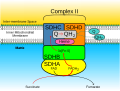 Diagram of succinate dehydrogenase
 -
 Oxidation of succinate via E2 mechanism
 -
 Oxidation of succinate via E1cb mechanism
 -
 Quinone mechanism in succinate dehydrogenase
 -
 Electron carriers in succinate dehydrogenase labeled


