Socialist economics: Difference between revisions
CSV import |
CSV import |
||
| Line 36: | Line 36: | ||
[[Category:Socialism]] | [[Category:Socialism]] | ||
{{Economics-stub}} | {{Economics-stub}} | ||
<gallery> | |||
File:Charles_Fourier_(by_Hans_F._Helmolt).jpg|Charles Fourier | |||
File:Karl_Marx_001.jpg|Karl Marx | |||
File:La_conquête_du_pain.jpg|La conquête du pain | |||
File:Albert_Einstein_Head.jpg|Albert Einstein | |||
File:CyberSyn-render-106.png|Socialist economics | |||
File:Portrait_of_Leon_Trotsky.jpg|Leon Trotsky | |||
</gallery> | |||
Latest revision as of 11:01, 18 February 2025
| Economics |
|---|
|
[[File:
 |200px|center|alt=]] |200px|center|alt=]]
|
| Socialism |
|---|
|
[[File:
 |200px|center|alt=]] |200px|center|alt=]]
|
Socialist economics refers to the economic theories, practices, and norms of hypothetical and existing socialist societies. A socialist economic system is characterized by social ownership and democratic control of the means of production, as opposed to the capitalist economic system, which is based primarily on private ownership and market regulation.
Overview[edit]
Socialist economics encompasses various economic theories that advocate for the production, distribution, and exchange of goods and services to be managed by the community as a whole or by a centralized government that often plans and controls the economy. One of the foundational principles of socialist economics is the abolition of private property in the means of production so that capital goods are owned by the public or the state, and the surplus value generated by enterprises is controlled in a manner that benefits the public good.
Historical Development[edit]
The roots of socialist economics can be traced back to the works of Karl Marx and Friedrich Engels, who outlined the basis for a socialist economy in their critique of capitalism. The 20th century saw various attempts at establishing socialist economies, most notably in the Soviet Union under Vladimir Lenin and Joseph Stalin, and in China under Mao Zedong. These economies were marked by state ownership of the means of production, central planning, and the attempt to eliminate the market forces influencing the economy.
Models of Socialist Economics[edit]
Planned Economy[edit]
A planned economy is one in which economic decisions are made by centralized government through a planning process. The Soviet model of economic development is one of the most well-known examples of a planned economy, where all significant economic decisions were made by the central government.
Market Socialism[edit]
Market socialism is a type of socialist economics that incorporates elements of the market within a socialist framework. In this model, enterprises are owned and managed cooperatively or by the state, but they operate in a market environment to meet consumer demands. Examples include the Yugoslav model of worker self-management.
Democratic Socialism[edit]
Democratic socialism combines elements of socialism with democratic political systems. It seeks to propagate the ideals of socialism within the framework of a democratic state. This model emphasizes a gradual transition from capitalism to socialism by democratic means, focusing on social ownership with constitutional protections and democratic governance.
Criticism and Challenges[edit]
Socialist economics has faced various criticisms, notably for issues of economic inefficiency, lack of incentive, and bureaucratic management leading to ineffective resource distribution. Critics argue that the absence of market mechanisms can lead to the misallocation of resources and stifle innovation.
Contemporary Relevance[edit]
In the 21st century, interest in socialist economics has resurfaced, particularly in the context of growing economic inequality and debates over the sustainability of the capitalist system. Discussions often focus on finding a balance between market mechanisms and social ownership to address these issues.
See Also[edit]

-
 Charles Fourier
 -
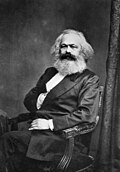 Karl Marx
 -
 La conquête du pain
 -
 Albert Einstein
 -
 Socialist economics
 -
 Leon Trotsky
.jpg)


