Nucleic acid double helix: Difference between revisions
CSV import |
CSV import |
||
| Line 37: | Line 37: | ||
{{DNA}} | {{DNA}} | ||
{{Genetics-stub}} | {{Genetics-stub}} | ||
<gallery> | |||
File:DNA_orbit_animated_static_thumb.png|Nucleic acid double helix | |||
File:CCF10292011_00000.jpg|Nucleic acid double helix | |||
File:Dnaconformations.png|Nucleic acid double helix | |||
File:B&Z&A_DNA_formula.svg|Nucleic acid double helix | |||
File:DNA-ligand-by-Abalone.png|Nucleic acid double helix | |||
File:Circular_DNA_Supercoiling.png|Nucleic acid double helix | |||
</gallery> | |||
Latest revision as of 10:59, 18 February 2025
Nucleic Acid Double Helix
The nucleic acid double helix is a fundamental structure underlying the life sciences, representing the physical form in which DNA (deoxyribonucleic acid) and, in some cases, RNA (ribonucleic acid) exist. This structure is pivotal in the storage and expression of genetic information, playing a crucial role in processes such as replication, transcription, and genetic recombination.
Structure[edit]
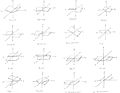
The double helix model of DNA was first proposed by James Watson and Francis Crick in 1953, building upon the X-ray diffraction images produced by Rosalind Franklin. The structure consists of two long strands of nucleotides twisted around each other, resembling a twisted ladder or a spiral staircase. Each nucleotide comprises a sugar (deoxyribose in DNA, ribose in RNA), a phosphate group, and one of four nitrogenous bases: adenine (A), thymine (T), cytosine (C), or guanine (G). In RNA, uracil (U) replaces thymine.
The two strands are antiparallel, meaning they run in opposite directions, and are held together by hydrogen bonds between the nitrogenous bases. Adenine pairs with thymine (or uracil in RNA) through two hydrogen bonds, while cytosine pairs with guanine through three hydrogen bonds. This pairing is known as the base-pairing rule and is critical for the fidelity of DNA replication and RNA transcription.
Function[edit]
The nucleic acid double helix serves several essential functions in the cell:
- Storage of Genetic Information: The sequence of bases along the DNA strand encodes the genetic instructions for the development, functioning, growth, and reproduction of all known living organisms and many viruses.
- Replication: DNA replication allows for the genetic information to be passed from cell to cell and from generation to generation. The double helix unwinds and each strand serves as a template for the formation of a new complementary strand.
- Transcription and Translation: In the process of transcription, a segment of DNA is copied into RNA. This RNA, in turn, serves as a template for protein synthesis during translation, effectively converting the genetic code into a functional product.
- Repair and Recombination: The double helix structure facilitates the repair of damaged DNA and the recombination of genetic material, ensuring genetic diversity and integrity.
Historical Significance[edit]
The discovery of the double helix structure marked a milestone in the field of molecular biology, providing the first clear picture of DNA's role in heredity and genetic expression. It laid the groundwork for modern genetic research, including the Human Genome Project, and has applications in forensic science, biotechnology, and medicine.
See Also[edit]
References[edit]
<references/>
| Y-STR Name |
| Haplotype |

-
 Nucleic acid double helix
 -
 Nucleic acid double helix
 -
 Nucleic acid double helix
 -
 Nucleic acid double helix
 -
 Nucleic acid double helix
 -
 Nucleic acid double helix


