Foal: Difference between revisions
CSV import |
CSV import |
||
| Line 37: | Line 37: | ||
{{Animal-stub}} | {{Animal-stub}} | ||
<gallery> | |||
File:Standingarabianfoalone.jpg|Foal | |||
File:Mare_and_colt.JPG|Mare and colt | |||
File:Jeju_horse_(mother_and_daughter).jpg|Jeju horse (mother and daughter) | |||
File:Poulain_ardennais_02.jpg|Foal | |||
File:Tv-Blue-Butterfly.jpg|Foal | |||
File:Verden_-Pferde_in_der_Koppel.jpg|Foal | |||
</gallery> | |||
Latest revision as of 10:58, 18 February 2025
Foal is a term used to describe a young horse of either sex that is no more than one year old. The process of giving birth in horses is known as "foaling," and it is a significant event in the lifecycle of a horse. This article provides an overview of the characteristics, development, and care of foals.
Characteristics[edit]
Foals are born after a gestation period of approximately 11 months. At birth, a foal's legs are almost as long as those of an adult horse, making up about 80-90% of their adult length. This characteristic enables them to run from predators shortly after birth. Foals typically stand and nurse from their mother, known as a mare, within the first hour of life. This early intake of the mare's milk, which contains essential antibodies, is crucial for the foal's immune system.
Development[edit]
The development of a foal can be divided into several stages:
Neonatal Period[edit]
The first 24 hours after birth are critical for a foal's survival. During this time, it is important that the foal receives adequate colostrum from the mare, as it contains antibodies necessary for the foal's immune system.
Suckling Foal[edit]
A foal is considered a suckling until it is weaned from its mother's milk. Weaning can occur from four months of age but may vary depending on the condition of the mare and the foal's development.
Weanling[edit]
Once weaned, the foal becomes a weanling. During this stage, the foal continues to grow rapidly and begins to eat more solid food, such as hay and grain.
Yearling[edit]
At the age of one, the foal is referred to as a yearling. Yearlings continue to grow and develop and may begin basic training, depending on their intended use.
Care[edit]
Proper care of foals is essential for their development into healthy adult horses. Key aspects of foal care include:
- Nutrition: Foals require a diet that supports their rapid growth. This includes high-quality mare's milk initially, followed by a balanced diet of hay, grain, and minerals as they grow.
- Healthcare: Regular veterinary check-ups are important to ensure that the foal is developing correctly and to administer necessary vaccinations and deworming treatments.
- Socialization: Early socialization with humans and other horses is important for the foal's behavioral development.
- Training: Basic training, such as halter training and leading, can begin at a young age to prepare the foal for future handling and work.
Breeding and Genetics[edit]
Selective breeding can influence the characteristics and abilities of foals. Breeders may select for traits such as speed, endurance, and temperament, depending on the breed and intended use of the horse.
Conclusion[edit]
Foals represent the future of the equine world, embodying potential, growth, and the continuation of breeds. Proper care, nutrition, and training during the early stages of a foal's life are crucial for its development into a healthy and well-adjusted adult horse.
.png)
-
 Foal
Foal -
 Mare and colt
 -
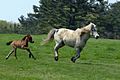 Jeju horse (mother and daughter)
 -
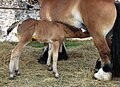 Foal
Foal -
 Foal
Foal -
 Foal
Foal


.jpg)


