Pudding: Difference between revisions
CSV import |
CSV import |
||
| Line 40: | Line 40: | ||
[[Category:Desserts]] | [[Category:Desserts]] | ||
{{food-stub}} | {{food-stub}} | ||
<gallery> | |||
File:Blanc-manger_on_glass_platter,_full_view.jpg|Blanc-manger on glass platter | |||
File:Haggis_with_a_CC_license.jpg|Haggis | |||
File:Pudding_With_Raspberries_and_Whipped_Cream.jpg|Pudding with raspberries and whipped cream | |||
File:Kheer.jpg|Kheer | |||
File:Christmas_pudding.JPG|Christmas pudding | |||
File:Chocolate_pudding.jpg|Chocolate pudding | |||
</gallery> | |||
Revision as of 10:58, 18 February 2025

| |
| A variety of puddings | |
| Alternative names | |
| Type | |
| Course | Dessert |
| Place of origin | Various |
| Region or state | |
| Associated national cuisine | |
| Created by | |
| Invented | |
| Cooking time | minutes to minutes |
| Serving temperature | Varies |
| Main ingredients | Milk, sugar, butter, flour |
| Ingredients generally used | |
| Variations | Chocolate, vanilla, tapioca, rice pudding |
| Food energy | kcal |
| Nutritional value | Protein: g, Fat: g, Carbohydrate: g |
| Glycemic index | |
| Similar dishes | |
| Other information | |
| Website | [ Official website] |
Pudding is a type of food that can be either a dessert or a savory dish. The term "pudding" is believed to come from the French word "boudin", originally from the Latin "botellus", meaning "small sausage", referring to encased meats used in Medieval European puddings. In modern times, the term has come to denote a wide range of dishes, from sweet, rich desserts to savory steamed dishes made with meat or fish.
History
The history of pudding is diverse, with its origins dating back to the Middle Ages. Initially, puddings were primarily savory dishes made with meat, blood, and grains, and were boiled in animal stomachs or intestines. Over time, the concept of pudding evolved, especially in Britain, to include sweet and savory dishes, often steamed or boiled. The 19th century saw the advent of dessert puddings made with milk, sugar, and flavors like chocolate or vanilla, resembling what most people today consider pudding.
Types
Pudding can be divided into two main categories: sweet and savory.
Sweet Puddings
Sweet puddings are typically served as desserts and include varieties such as:
- Chocolate pudding, made with milk, sugar, and cocoa.
- Vanilla pudding, flavored primarily with vanilla.
- Rice pudding, made from rice mixed with water or milk and other ingredients such as cinnamon and raisins.
- Tapioca pudding, made with tapioca pearls.
Savory Puddings
Savory puddings are less common but include dishes such as:
- Black pudding, a type of blood sausage.
- Yorkshire pudding, made from a batter of eggs, flour, and milk or water, traditionally served with roast beef.
- Suet pudding, made with suet (animal fat) and flour, often containing meat or fruits.
Preparation
The preparation of pudding varies widely depending on the type. Sweet puddings are often made by combining milk or cream with sugar, flavorings, and a thickening agent such as cornstarch or eggs, then cooking the mixture until it thickens. Savory puddings, on the other hand, may involve mixing meat, vegetables, or other ingredients with a batter or dough and then steaming or baking the mixture.
Cultural Significance
Pudding holds a significant place in various cultures. In the United Kingdom, pudding is an essential part of traditional meals, with dishes like Christmas pudding and steak and kidney pudding being staples. In the United States, pudding typically refers to sweet, creamy desserts similar to what is known as custard in other parts of the English-speaking world.
See also

-
 Blanc-manger on glass platter
 -
 Haggis
 -
 Pudding with raspberries and whipped cream
 -
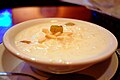 Kheer
Kheer -
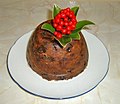 Christmas pudding
 -
 Chocolate pudding


