Papillary muscle: Difference between revisions
CSV import Tags: mobile edit mobile web edit |
CSV import |
||
| Line 27: | Line 27: | ||
[[Category:Muscular system]] | [[Category:Muscular system]] | ||
{{stub}} | {{stub}} | ||
== Papillary_muscle == | |||
<gallery> | |||
File:Papillary_muscles.png|Papillary muscles | |||
File:Gray1218.png|Diagram of the heart showing papillary muscles | |||
File:Heart_short_axis_view_papillary.jpg|Short axis view of the heart showing papillary muscles | |||
File:Gross_pathology_of_papillary_muscle_infarction.jpg|Gross pathology of papillary muscle infarction | |||
File:Muscolopapillare+cordetendinee.jpg|Papillary muscle and chordae tendineae | |||
File:Muscolopapillarex.jpg|Papillary muscle | |||
File:Slide16bek.JPG|Papillary muscle | |||
</gallery> | |||
Latest revision as of 10:56, 18 February 2025
Papillary muscle refers to the muscles located in the ventricles of the heart. They attach to the cusps of the atrioventricular valves (also known as the mitral and tricuspid valves) via the chordae tendineae and contract to prevent inversion or prolapse of these valves on systole (or ventricular contraction). The papillary muscles constitute about 10% of the total heart mass.
Anatomy[edit]
There are five total papillary muscles in the heart, three in the right ventricle and two in the left. The muscles in the right ventricle are called the anterior, posterior, and septal muscles. They are named for their position in the right ventricle. The two papillary muscles in the left ventricle are called the anterior and posterior muscles.
Function[edit]
The primary role of the papillary muscles is to keep the atrioventricular valves from prolapsing into the atria when the ventricles contract. If the papillary muscles are damaged due to a myocardial infarction (heart attack), the result can be mitral regurgitation.
Clinical significance[edit]
Damage to the papillary muscle can lead to complications such as Mitral regurgitation, where the mitral valve does not close properly and blood flows backward into the heart. This can lead to symptoms such as fatigue, shortness of breath, and palpitations.
See also[edit]
References[edit]
<references />
 | |
|---|---|
 |
 |
Papillary_muscle[edit]
-
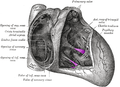 Papillary muscles
 -
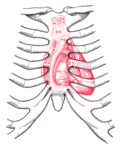 Diagram of the heart showing papillary muscles
 -
 Short axis view of the heart showing papillary muscles
 -
 Gross pathology of papillary muscle infarction
 -
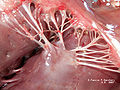 Papillary muscle and chordae tendineae
 -
 Papillary muscle
 -
 Papillary muscle


