Pseudoxanthoma elasticum: Difference between revisions
CSV import Tag: Replaced |
CSV import |
||
| Line 35: | Line 35: | ||
{{stub}} | {{stub}} | ||
== Pseudoxanthoma_elasticum == | |||
<gallery> | |||
File:Pseudoxanthoma_elasticum_3.JPG|Pseudoxanthoma elasticum | |||
File:autorecessive.svg|Autosomal recessive inheritance pattern | |||
File:Histopathology_of_pseudoxanthoma_elasticum.jpg|Histopathology of pseudoxanthoma elasticum | |||
File:PXE-like_papillary_dermal_elastolysis.jpg|PXE-like papillary dermal elastolysis | |||
File:Histopathology_of_PXE-like_papillary_dermal_elastolysis.jpg|Histopathology of PXE-like papillary dermal elastolysis | |||
File:Pseudoxanthoma_elasticum_1.JPG|Pseudoxanthoma elasticum | |||
File:Pseudoxanthoma_elasticum_2.JPG|Pseudoxanthoma elasticum | |||
</gallery> | |||
Revision as of 10:56, 18 February 2025
Pseudoxanthoma elasticum (PXE), also known as Grönblad–Strandberg syndrome, is a rare, inherited disorder that causes calcium and other minerals to accumulate in the body's soft tissues. This accumulation can result in changes to the skin, eyes, cardiovascular system, and gastrointestinal system.
Signs and Symptoms
The signs and symptoms of PXE vary widely among affected individuals. Some people may have severe symptoms, while others may have only mild signs of the disorder. The most common symptoms include:
- Skin changes: The skin may become loose, saggy, and wrinkled. It may also develop small, yellowish bumps.
- Eye changes: PXE can cause changes to the retina, which can lead to vision loss.
- Cardiovascular problems: PXE can cause narrowing of the blood vessels, which can lead to heart disease and stroke.
- Gastrointestinal problems: Some people with PXE may experience gastrointestinal bleeding.
Causes
PXE is caused by mutations in the ABCC6 gene. This gene provides instructions for making a protein that is involved in the transport of certain molecules across cell membranes. Mutations in the ABCC6 gene disrupt this transport process, leading to the accumulation of minerals in the body's soft tissues.
Diagnosis
The diagnosis of PXE is based on the presence of characteristic signs and symptoms, a family history of the disorder, and genetic testing to identify mutations in the ABCC6 gene.
Treatment
There is currently no cure for PXE. Treatment is aimed at managing the symptoms and preventing complications. This may include regular eye exams to monitor for changes in vision, medications to manage cardiovascular problems, and surgery to remove excess skin.
See Also
References
<references />
 | |
|---|---|
 |
 |
Pseudoxanthoma_elasticum
-
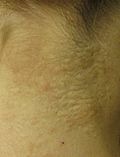 Pseudoxanthoma elasticum
 -
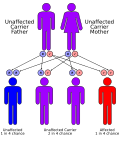 Autosomal recessive inheritance pattern
 -
 Histopathology of pseudoxanthoma elasticum
 -
 PXE-like papillary dermal elastolysis
 -
 Histopathology of PXE-like papillary dermal elastolysis
 -
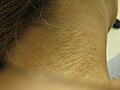 Pseudoxanthoma elasticum
 -
 Pseudoxanthoma elasticum


