Periaqueductal gray: Difference between revisions
CSV import Tags: mobile edit mobile web edit |
CSV import |
||
| Line 28: | Line 28: | ||
[[Category:Pain]] | [[Category:Pain]] | ||
[[Category:Midbrain]] | [[Category:Midbrain]] | ||
<gallery> | |||
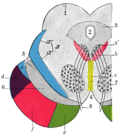
File:cn3nucleus-en.svg|Diagram of the oculomotor nerve nucleus | |||
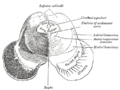
File:Gray710.png|Transverse section of mid-brain at level of superior colliculi | |||
File:Gray678.png|Coronal section of mid-brain | |||
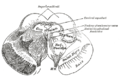
File:Gray711.png|Transverse section of mid-brain at level of inferior colliculi | |||
File:Gray712.png|Transverse section of mid-brain at level of inferior colliculi | |||
File:Periaqueductal_MRI.PNG|Periaqueductal gray on MRI | |||
</gallery> | |||
Latest revision as of 05:06, 18 February 2025
Periaqueductal gray (PAG) is a region located around the cerebral aqueduct within the tegmentum of the midbrain. It plays a crucial role in the modulation of pain and in defensive and reproductive behaviors.
Anatomy[edit]
The periaqueductal gray is so named because it is gray matter situated around the cerebral aqueduct. This region of the brain is involved in numerous functions, including the perception of pain. The PAG is divided into four columns: the dorsomedial, dorsolateral, lateral, and ventrolateral columns. Each column is associated with different functions.
Function[edit]
The PAG plays a key role in the body's response to pain, and is involved in the endogenous analgesia system. It has connections with other areas of the brain that are involved in pain perception, including the thalamus, hypothalamus, and amygdala. The PAG also has a role in defensive and reproductive behaviors.
Clinical significance[edit]
The PAG has been implicated in various conditions related to pain, including chronic pain and migraine. It is also involved in the body's response to stress and anxiety. Understanding the role of the PAG in these conditions could lead to new treatments.
See also[edit]
References[edit]
<references />
 | |
|---|---|
 |
 |
-
 Diagram of the oculomotor nerve nucleus
 -
 Transverse section of mid-brain at level of superior colliculi
 -
 Coronal section of mid-brain
 -
 Transverse section of mid-brain at level of inferior colliculi
 -
 Transverse section of mid-brain at level of inferior colliculi
 -
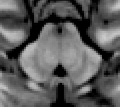 Periaqueductal gray on MRI


