Counts per minute: Difference between revisions
CSV import Tags: mobile edit mobile web edit |
CSV import |
||
| Line 44: | Line 44: | ||
[[Category:Environmental Monitoring]] | [[Category:Environmental Monitoring]] | ||
[[Category:Data Analysis]] | [[Category:Data Analysis]] | ||
<gallery> | |||
File:Geiger_counter_in_use.jpg|Geiger counter in use | |||
File:Radioactivity_and_radiation.png|Radioactivity and radiation | |||
File:US_Navy_070208-N-9132D-002_Electronics_Technician_2nd_Class_Shea_Thompson_tests_an_Alpha_Particle_Dection_Probe.jpg|Electronics Technician testing an Alpha Particle Detection Probe | |||
</gallery> | |||
Latest revision as of 05:05, 18 February 2025
Counts per minute (CPM) is a commonly used unit of measurement in various fields, including radiation detection, environmental monitoring, and data analysis. It represents the number of events or occurrences that take place within a span of one minute. CPM is particularly useful in situations where the rate of events needs to be monitored or analyzed over time.
Definition and Calculation[edit]
CPM is calculated by counting the number of events that occur within a one-minute interval. These events can vary depending on the context in which CPM is being used. For example, in radiation detection, CPM refers to the number of radioactive particles or photons detected within a minute.
To calculate CPM, one needs to have a reliable method of event detection and counting. This can be achieved using specialized equipment such as Geiger-Muller counters or scintillation detectors. These devices are designed to detect and measure specific types of events, such as radioactive decay or particle interactions.
Once the events are detected, the count is recorded and divided by the duration of one minute to obtain the CPM value. For example, if 100 events are detected within a minute, the CPM would be 100.
Applications[edit]
CPM has various applications across different fields:
Radiation Detection[edit]
In the field of radiation detection, CPM is used to measure the intensity of radiation in a given area. This is particularly important in nuclear power plants, medical facilities, and other environments where radiation exposure needs to be monitored. By measuring the CPM, professionals can assess the potential risks and take appropriate safety measures.
Environmental Monitoring[edit]
CPM is also used in environmental monitoring to measure the concentration of pollutants or other harmful substances in the air, water, or soil. By continuously monitoring the CPM, scientists and environmentalists can identify potential sources of contamination and take necessary actions to mitigate the impact on ecosystems and human health.
Data Analysis[edit]
In data analysis, CPM is often used to analyze patterns and trends in large datasets. By calculating the CPM for specific events or variables, researchers can identify correlations, anomalies, or changes over time. This can be particularly useful in fields such as finance, marketing, and social sciences.
Limitations[edit]
While CPM is a useful measurement unit, it does have some limitations:
Time Resolution[edit]
CPM provides a measure of events within a one-minute interval. However, in some cases, a higher time resolution may be required to capture rapid changes or fluctuations. In such cases, alternative units such as counts per second (CPS) or counts per hour (CPH) may be more appropriate.
Event Definition[edit]
The definition of an event can vary depending on the context. For example, in radiation detection, an event may refer to the detection of a single radioactive particle. However, in other applications, such as data analysis, the definition of an event may be more subjective and dependent on the specific research question.
Equipment Calibration[edit]
To ensure accurate measurements, it is crucial to calibrate the equipment used for event detection. This involves comparing the device's response to known standards or reference sources. Regular calibration helps maintain the accuracy and reliability of CPM measurements.
See Also[edit]
References[edit]
<references />
-
 Geiger counter in use
 -
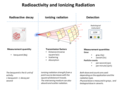 Radioactivity and radiation
 -
 Electronics Technician testing an Alpha Particle Detection Probe


